

A patient walks in speaking Haitian Creole. A deputy needs a witness statement at 2 a.m. A contractor has ten minutes with a supplier before the concrete truck arrives. All three need an interpreter, and not the same kind.
Over the Phone vs Traditional Interpretation at a Glance
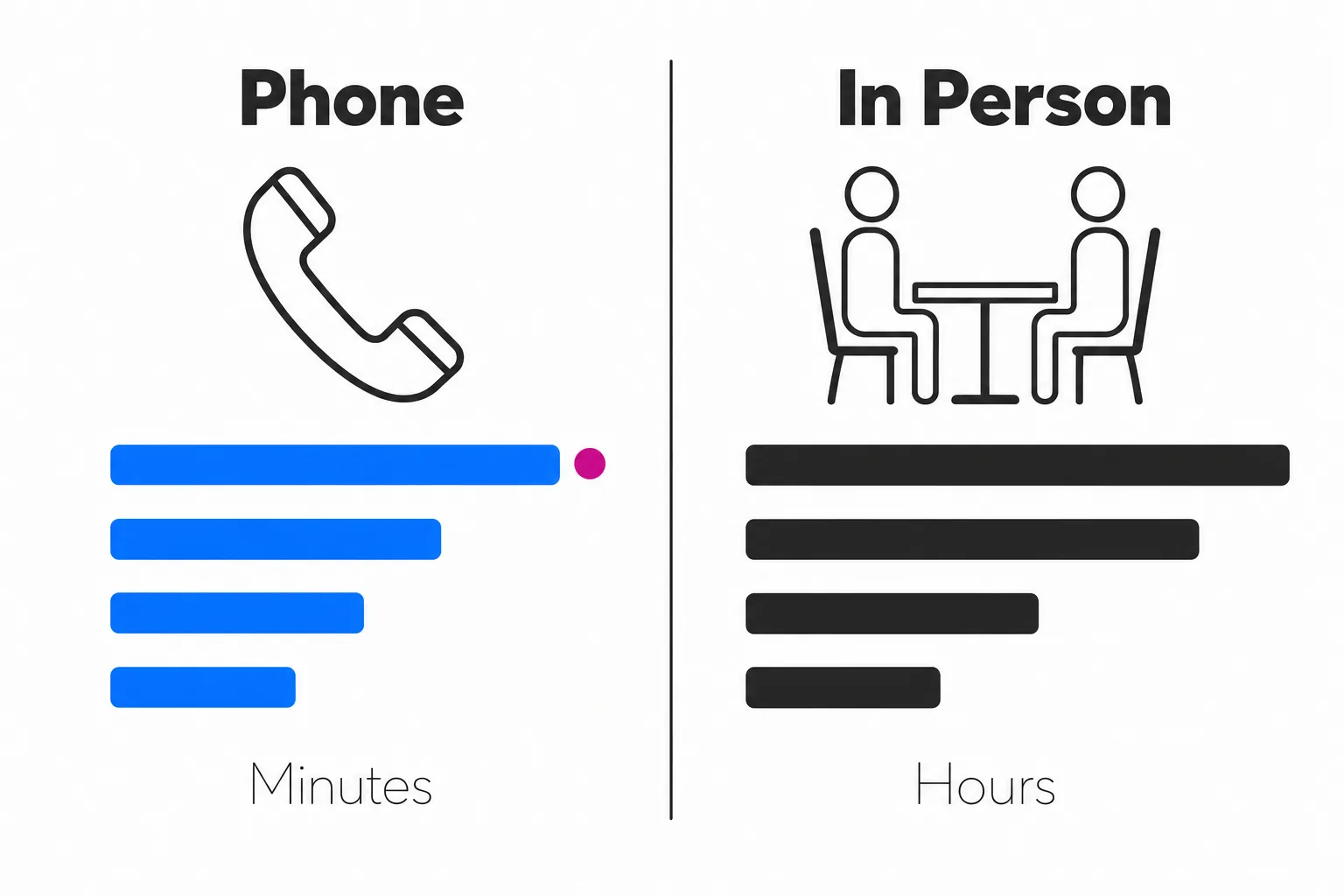
In this guide, “traditional interpretation” means an interpreter who attends the interaction in person or on-site.
Over-the-phone interpretation (OPI) connects participants to a remote interpreter by phone and is often suitable for short, urgent, or routine exchanges. Traditional in-person interpretation puts a qualified linguist in the room and fits long, complex, or emotionally sensitive settings.
Neither is the better service. They are two delivery channels within the same profession, and qualified interpreters should follow the ethical and professional standards applicable to their setting.
The comparison below covers the factors that settle most decisions:
| Factor | Over-the-phone interpretation | Traditional in-person interpretation |
|---|---|---|
| Connection time | Usually within a minute for common languages | Typically requires advance scheduling |
| Scheduling | Available on demand without booking | Requires a scheduled, locally available interpreter |
| Cost structure | Billed by connected minutes, with no travel expense | Usually billed by the hour with minimums and possible travel charges |
| Visual context | Audio only | Full access to facial expressions, gestures, documents, and physical surroundings |
| Session length | Best suited to short, urgent, or routine exchanges | Better suited to longer, complex, formal, or multi-party sessions |
| Equipment and call quality | Requires a clear phone connection, quiet setting, speakerphone, dual handset, or headset | Requires an appropriate meeting space and may need conference equipment for simultaneous interpreting |
| Language availability | Draws from a broad remote interpreter pool | Depends on qualified interpreter availability in the local area |
| Typical settings | Intake, dispatch, follow-ups, appointments, and unplanned requests | Proceedings, conferences, classrooms, evaluations, and site walks |
Quick Pros and Limitations
- OPI advantages: Immediate remote access without interpreter travel, including strong support for after-hours and unexpected language requests.
- OPI limitations: No visual cues; call quality can be affected by weak signals, background noise, echo, or participants speaking over one another.
- In-person advantages: Full visual and environmental context, stronger support for lengthy or complex sessions, and access to conference or accessibility equipment when needed.
- In-person limitations: Advance scheduling, local interpreter availability, booking minimums, travel costs, and cancellation terms.
What Is Over the Phone Interpretation (OPI)?
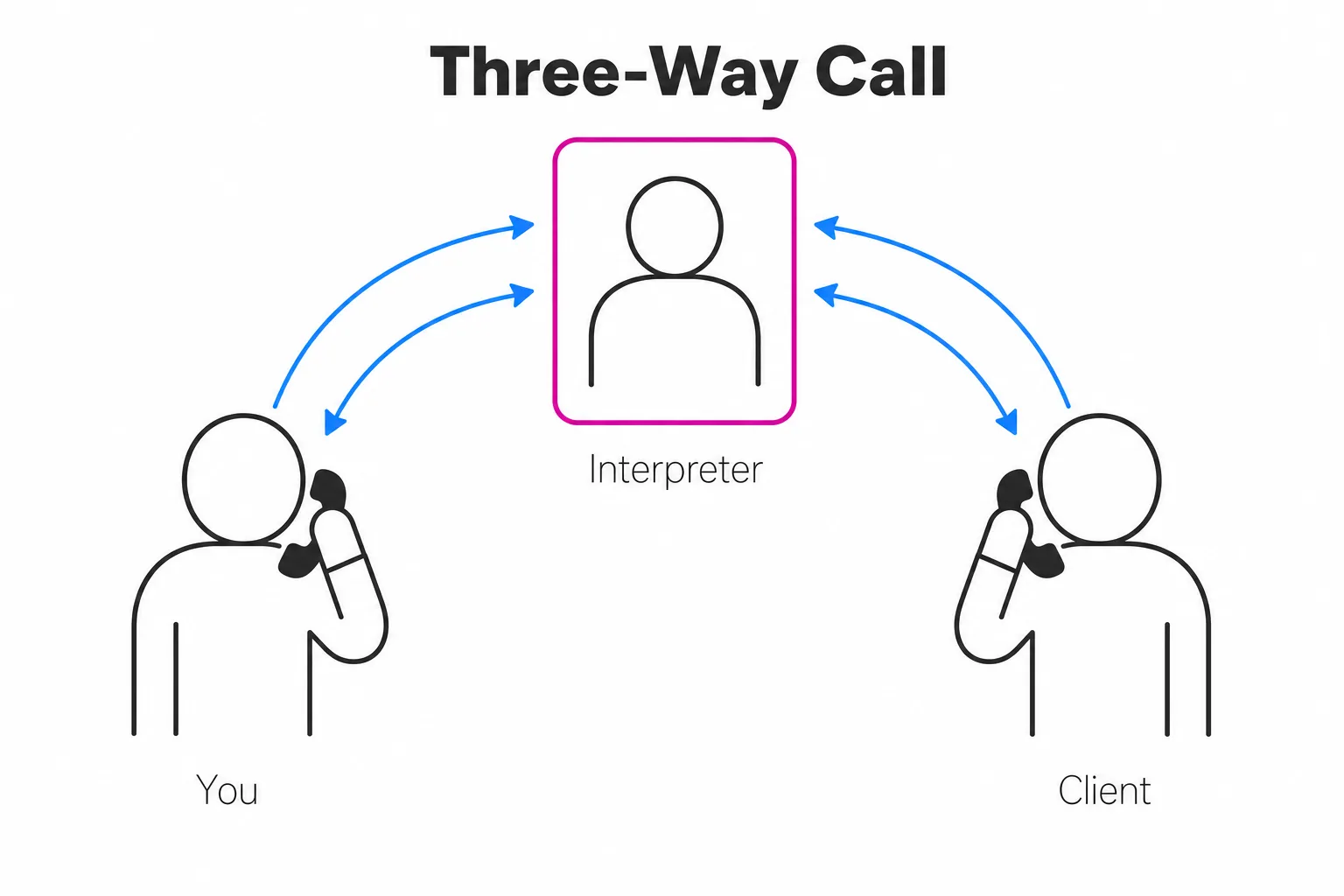
OPI is a three-way phone call: you, the person you need to speak with, and a professional interpreter. No app to learn, no equipment beyond the phone already on the desk.
The interpreter listens to each speaker, renders the meaning into the other language, and manages turn-taking so nobody talks over anybody. That is the whole job. A phone interpreter does not give advice, answer on your behalf, or soften what either side says.
“OPI” is the standard shorthand for over-the-phone interpretation. Phone interpreting and telephone interpretation mean the same thing.
On the grammar question that trips people up: “over the phone” is correct standard English. Hyphenate it (over-the-phone) only when it sits directly in front of a noun, as in “over-the-phone interpretation.”
How an OPI Call Works, Step by Step
1. Dial the access number, or add the interpreter to a conference line or meeting already running. 2. Give your account or PIN details and name the language you need. 3. Get connected to an available interpreter. Connection time may depend on the language, specialization, demand, and provider capacity. 4. Speak in short segments and pause. Phone interpreting runs in consecutive mode, so the interpreter renders each chunk before you continue. 5. For a face-to-face conversation with one remote interpreter, use a speakerphone or a dual handset, or pass a headset back and forth.
Round-the-clock coverage and a deep language pool make this practical. With 350+ languages available 24/7/365, a 2 a.m. Ojibwe or Pashto request becomes a phone call instead of a search.
Equipment and Call-Quality Checklist for OPI
- Use a quiet location with a stable phone or internet connection.
- Choose a speakerphone, dual handset, or headset that allows every participant to hear clearly.
- Confirm the correct language and dialect before the conversation begins.
- Introduce every person in the room and briefly explain the purpose of the call.
- Speak directly to the other participant, use first person, and pause in short segments.
- Avoid side conversations, background movement, and multiple people speaking at once.
- Describe any document, screen, object, or gesture the remote interpreter cannot see.
- Confirm important names, numbers, dates, instructions, and next steps before ending.
What Is Traditional In-Person Interpretation?
On-site interpreting means a qualified interpreter is physically present: courtroom, clinic, classroom, job walk, conference hall.
Being in the room unlocks modes the phone cannot support well:
- Simultaneous interpretation with booths, transmitters, and receivers for conferences.
- American Sign Language, which is visual by definition.
- Long consecutive with note-taking, used for testimony and formal statements.
On-site accessibility support may also include CART captioning, which converts spoken content into real-time text but is distinct from language interpretation.
The interpreter also reads the room: who is speaking to whom, the gesture toward the second-floor framing, the exhibit handed to a witness. That context removes ambiguity before it becomes an error.
The trade-off is logistics: advance scheduling, a linguist available in your area, and usually a minimum booking block plus travel time.
OPI vs In-Person Interpretation Cost
OPI is billed by the minute. No mileage, no parking, no minimum hour. A five-minute call costs five minutes.
In-person is billed by the hour against a minimum engagement, and the invoice can include travel time, mileage, and a cancellation window if the meeting moves.
The gap is widest on short interactions and narrowest on full-day assignments. A four-minute appointment confirmation is far cheaper by phone. An all-day hearing is closer to a wash, and the on-site interpreter delivers more for the money.
Rare languages skew it further. A local interpreter for a low-incidence language may not exist in your city at any price, while a phone service draws from a national pool.
As for what interpreters charge per hour, any single number would mislead you: rates move with language pair, certification level, setting, delivery mode, and time of day. Price it against your actual mix of calls and appointments. Our breakdown of over-the-phone interpreting cost compared to in-person walks through how those line items stack up. Public-sector buyers have a shortcut: government, education, nonprofit, tribal, and Canadian MASH agencies can use pre-negotiated pricing through CCI Group’s Sourcewell contract (#081225-IDY) instead of running a full RFP.
Related readingHow Much Does Video Remote Interpreting Cost for a BusinessRead the guide →OPI vs In-Person Interpretation: Speed and Availability
OPI removes the scheduling step entirely. In some settings, that decides the whole question.
Emergency dispatch, hospital intake, a front desk with a walk-in, an officer taking a statement at the roadside: those conversations happen now or not at all. On-site coverage typically needs days of notice, more for less common languages.
The coverage math also favors a national pool on nights, weekends, and holidays, when local calendars are empty. The same on-demand access serves the contractor who lands a last-minute client meeting or needs a supplier order sorted before the crew stands idle. Our overview of how phone interpreting helps businesses communicate across language barriers covers those everyday situations.
Is OPI as Accurate as In-Person Interpretation?
In-person interpretation provides more visual and environmental information. Facial expression, gaze direction, gesture, shared documents, and physical objects all narrow down what a speaker means.
Phone has one underrated advantage: no third person in the room. Some speakers disclose sensitive information more freely to a voice than to a stranger sitting across the table, which matters in domestic violence intake and parts of a medical history.
Many OPI communication risks can be reduced through appropriate equipment, a quiet environment, clear turn-taking, and sufficient context for the interpreter.
Accuracy tracks interpreter qualification more than channel.
Certified legal interpreters and HIPAA-compliant medical interpreters work in both modes. Interpreter qualification, subject-matter competence, and communication conditions can matter more than physical location alone.
Research comparing medical interpreting channels adds useful nuance: one study found that providers and interpreters rated in-person encounters more highly, while patients rated the methods similarly. Treat this as one study rather than a universal rule, because setting, technology, interpreter qualification, and communication needs all affect the result.
Five Common Interpreting Errors and How the Channel Affects Them
Five error types recur across professional interpreting, and each has a practical countermeasure:
1. Omission. Part of the message gets dropped. Most likely when someone talks for two minutes without pausing, which happens more on the phone because there is no visual cue prompting them to stop. 2. Addition. The interpreter inserts explanation, side commentary, or an answer nobody asked for. 3. Substitution. A similar but wrong term gets swapped in. Technical vocabulary is where this bites hardest: permit categories, charging language, construction specs, dosages. 4. Loss of first person. The interpreter shifts to “he says that he was there,” which clouds the record in legal settings where the speaker’s own words are the evidence. 5. Role confusion. The interpreter drifts into acting as advocate, advisor, or gatekeeper.
The mitigations are identical in both channels and cost about a minute: brief the interpreter on the purpose before you start, speak in short segments, send terminology or case context ahead of a scheduled assignment, and make clear that the interpreter should ask for clarification rather than guess. On the phone, add one habit: say who is in the room and what document everyone is looking at.
Video Remote Interpreting: The Option Between the Two
Most comparisons stop at two choices. Video remote interpreting (VRI) keeps the remote speed and the by-the-minute cost structure while restoring the visual channel that OPI gives up. Because sign languages are visual, remote sign-language interpretation requires an appropriate video-based service rather than audio-only OPI. The ADA’s effective-communication guidance distinguishes VRI from video relay service and explains when video or on-site interpreting may be appropriate.
VRI runs through Zoom, Teams, and Webex integrations or a scheduling portal, so staff work inside tools they already use. Three things matter more here than with OPI: bandwidth, lighting, and camera framing. A signed conversation needs the interpreter’s hands and face fully in frame, steady, and well lit.
When to Use OPI, VRI, or In-Person Interpretation
Choose OPI for: intake and triage, appointment scheduling, dispatch and after-hours calls, short follow-up questions, unplanned walk-ins, rare languages, and quick client or supplier calls.
Choose in-person for: court proceedings, depositions and sworn testimony, IEP and disciplinary meetings, multi-party conferences, hands-on site walks and inspections, sessions running past roughly two hours, and conversations with a distressed speaker where rapport carries the meeting.
Courts set their own rules on when an interpreter must be physically present, so check the jurisdiction before booking remote coverage. The National Center for State Courts provides state court language-access resources.
Choose VRI for: sign language, remote panels, and anything where visual context matters but travel does not justify itself.
Most organizations blend all three: OPI as the always-on default, on-site booked ahead for high-stakes events, VRI when the conversation needs eyes.
One clarification worth making, because it causes real delays: contracts, permits, filings, and safety documents need translation, not interpretation. Translation is written work, priced by word count, language pair, certification requirement, and turnaround. Interpreting is spoken, priced by time. Review CCI Group’s certified document translation services when the content is written rather than spoken.
Security and Compliance Questions to Ask Any Provider
Criminal reports, witness statements, domestic violence disclosures, and patient records carry the same confidentiality weight on a phone line as in a room. Before signing with any provider, ask:
- Are linguists US-based and background-checked?
- Are medical assignments handled by HIPAA-compliant interpreters?
- Are legal interpreters certified for the setting they cover?
- How is call audio handled, and is anything recorded or retained?
- Can the provider produce usage records for language access reporting?
Many public agencies carry language access obligations they have to prove. Documented, on-demand coverage is easier to show than an ad hoc scramble to find a bilingual staff member. Organizations working in healthcare can also review the HHS guidance on language-assistance services when evaluating interpretation access and provider requirements.
Frequently asked questions
Is it correct to say “over the phone”?
What does an over the phone interpreter do?
What are the five common errors made by interpreters?
What do interpreters charge per hour?
Is phone interpreting less accurate than in-person interpreting?
Can I use OPI in a courtroom or for a deposition?
How fast can an interpreter join a call?
What is the difference between OPI and VRI?
Choose the Right Interpretation Service
Match the channel to three things: the stakes, the length, and whether anyone needs to see something. Short and urgent goes to the phone. Long, formal, or visual goes on-site or to video.
CCI Group interpreting service provides OPI, VRI, on-site interpretation, ASL support, CART captioning, and certified document translation under one account, with dedicated program managers who learn how your team actually works. Your staff never has to work out which vendor to call.
Tell us how your calls and appointments run, and we will send a custom pricing proposal within 24 hours. Or [call (727) 657-3167](tel:\(727\)%20657-3167) and talk it through.