

Most businesses pay for video remote interpreting by the minute, by the hour, or through a monthly plan. In 2026, a practical planning range is about $1.95 to $4.95 per minute for on-demand video remote interpretation, although specialized legal, healthcare, ASL, or rare-language sessions may cost more. In this article, we explore how VRI costs for businesses work, what affects business video interpreting rates, and how to choose a provider without paying for weak coverage, poor compliance, or unreliable access.
How much does video remote interpreting cost for a business
The honest answer to how much does video remote interpreting cost for a business is this: most companies should plan for about $2 to $5 per minute for on-demand VRI, or roughly $40 to $100+ per hour when the provider uses an hourly model. That range is broad, but it reflects the market. A five-minute customer service call in Spanish is not the same as a two-hour legal consultation with certified video remote interpreters. A school meeting with a parent, an HR investigation, a healthcare intake, and an emergency public-service call all carry different levels of risk.
That is where CCI Group’s role becomes important. The company is not just selling access to a video interpreter. It is built around mission-critical communication: language access, compliance, inclusion, and readiness for public-facing organizations that cannot afford unclear conversations. For businesses, schools, agencies, legal teams, healthcare offices, and community-serving organizations, video remote interpretation is often less about convenience and more about trust.
For a small business with occasional language needs, video interpretation costs may stay modest. A few short calls per month could cost less than a single in-person interpreter booking. For a hospital, law office, school district, insurance team, government office, or customer support center, the monthly spend can climb because language access is part of daily service delivery.
Here’s the thing: the rate is only half the story. A good video interpreting service helps staff serve people faster, reduces confusion, supports better decisions, and creates a recordable process for language access planning. In industries where accuracy matters, cheaper is not always cheaper.
The U.S. Department of Justice explains VRI in plain terms: “Video remote interpreting (VRI) is a fee-based service that uses video conferencing technology” to access an off-site interpreter in real time. That matters because VRI is not just a casual video call. It is a professional service designed to support effective communication.
Businesses usually turn to video remote interpretation when a phone-only conversation feels too limited. That may include medical intake, legal consultations, HR meetings, school conferences, financial discussions, public services, customer onboarding, or support for Deaf and hard-of-hearing people who use ASL.
For organizations that need interpreters across several settings, CCI Group’s professional interpreting services are especially relevant because the company supports phone, onsite, and remote interpreting in 350+ languages. That breadth matters when a business needs more than one language pathway: Spanish one day, a Vietnamese interpreter the next, ASL support during a meeting, and remote video interpretation for a high-risk client conversation.
Video remote interpreting cost by pricing model
Video remote interpreting providers do not all bill the same way. Some charge by the minute, some use hourly minimums, some offer monthly plans, and some quote custom rates for enterprise, healthcare, legal, education, or public-sector programs. That is why two vendors can quote very different interpretation services rates for what looks like the same request.
| Pricing model | Typical business use | Planning range | Best fit |
| Per-minute VRI | On-demand support, customer service, front desk, healthcare intake | $1.95–$4.95 per minute | Teams with unpredictable call volume |
| Hourly VRI | Scheduled meetings, interviews, legal consultations, training | $40–$100+ per hour | Planned sessions with known start and end times |
| Monthly plan | Repeated internal or customer-facing language needs | Custom quote | Businesses with steady usage |
| Event or RSI package | Webinars, conferences, town halls, simultaneous interpreting services | Custom half-day or full-day quote | Multi-speaker or multilingual events |
| ASL video interpreting | Deaf and hard-of-hearing access | Often premium priced | Healthcare, education, HR, government, public services |
Per-minute pricing looks simple, and for many companies, it is. Staff open a video remote interpreting app, choose the language, connect with an interpreter, and pay for the time used. This model works well when the language need may appear without notice.
Hourly pricing often makes more sense for planned meetings. If a law firm knows it has a one-hour client consultation, or an HR team has a scheduled employee meeting, an hourly quote may be cleaner than a meter that runs by the minute. For longer sessions, ask about minimum charges. Some vendors bill in 15-minute, 30-minute, one-hour, or two-hour blocks.
Monthly pricing can help if the business uses VRI often. A provider may offer better remote interpreting pricing when usage is predictable. This can help companies avoid surprise invoices, especially when several departments need access to virtual remote interpreting.
Remote simultaneous interpreting is its own category. For webinars, public meetings, conferences, and executive events, simultaneous interpreting services may require interpreters, tech support, prep time, audio channels, captions, and platform testing. In that case, the quote often looks more like an event budget than a simple telephone interpreting rate per minute.
What changes your interpreter cost
The first cost driver is language. Common languages, such as Spanish, French, or Mandarin, are usually easier to staff than rare languages or regional dialects. That does not mean Spanish translators or Spanish interpreters are “cheap.” It means supply is usually stronger, which can make scheduling easier. A Vietnamese interpreter, an interpreter for an Indigenous language, or a specialist in a less common dialect may cost more because the qualified talent pool is smaller.
The second factor is subject matter. A general customer service call and a court-admissible legal session do not require the same level of preparation. Legal, medical, financial, insurance, public-sector, and technical sessions may require interpreters with specific credentials and vocabulary. The more risk tied to the conversation, the more careful the match needs to be.
The third factor is timing. On-demand VRI costs more per minute than scheduled interpreting in many cases because the provider must keep interpreters ready. After-hours, weekend, urgent, or emergency sessions may also affect the price. No one loves a surcharge, but it is often tied to real staffing demands.
The fourth factor is platform setup. Some businesses only need a browser link. Others need a secure video remote interpreting platform, analytics, role-based access, reports, integrations, or workflow support. Healthcare teams may need HIPAA-aware processes. Schools may need FERPA-conscious communication. Public agencies may need language access reporting.
The fifth factor is quality control. A low interpreter cost may look attractive until a sensitive meeting goes sideways. Professional providers screen for language skill, ethics, confidentiality, and sector knowledge.
CCI Group’s interpreting model is a stronger fit for organizations that need more than a low rate. Its value sits in the combination of certified interpreters, remote and onsite coverage, ASL and accessibility support, and public-sector language access readiness.
VRI vs over-the-phone interpreter rates vs in person interpreter fees
Video remote interpretation sits between phone and onsite interpreting. If a visual channel is not strictly required, our guide explains when audio-only beats an in-person interpreter for a given appointment. It costs more than many phone interpreting plans, but it usually costs less than an in-person interpreter once travel time, mileage, parking, waiting time, and minimum booking windows enter the picture.
| Service type | Typical pricing style | Cost profile | Best use case |
| Over-the-phone interpreting | Per minute | Often lower than VRI | Fast, brief, transactional conversations |
| Video remote interpretation VRI | Per minute or hourly | Mid-range | Sensitive, visual, ASL, healthcare, legal, HR, education |
| In person interpreter | Hourly, half-day, full-day | Often higher after travel and minimums | Court, complex medical, high-stakes meetings, events |
| Remote simultaneous interpreting | Project or event quote | Higher but scalable | Webinars, conferences, town halls, multilingual meetings |
| Translation services | Per word, page, or hour | Separate from interpreting | Written documents, forms, contracts, records |
Over the phone interpreter rates are usually lower because there is no video layer, and the work suits shorter calls. A billing question, appointment reminder, delivery update, or simple support issue may not require visual context.
Video remote interpretation is the better fit when people need to see each other. Facial cues matter in healthcare, HR, legal, education, and public-service settings. VRI also becomes essential when a Deaf or hard-of-hearing person uses sign language. In those cases, phone support is not enough.
In person interpreting still has a place. A complex trial, multi-hour medical consultation, emotionally charged mediation, or public event may call for someone in the room. But for many business tasks, VRI cuts the wait time and removes travel-related costs.
That is why a business should not ask only what the cost of VRI services is. It should ask which interpreting mode fits the risk, setting, and audience. Pick the wrong mode, and the cheaper option can become expensive fast.
How does video remote interpreting work for business teams
A typical VRI session is straightforward. A staff member opens the video remote interpreting app or secure web portal, chooses the language, and connects with a qualified interpreter through live video. The interpreter joins remotely and supports the conversation in real time.
For planned meetings, the business may schedule the session in advance. The provider may ask for the language pair, subject, expected length, participant count, platform, and any prep materials. For legal, healthcare, or technical sessions, sharing a glossary, agenda, or document set can help the interpreter prepare.
For on-demand sessions, the workflow is faster. Staff choose the language, enter the session, and wait for a match. A strong video interpreting service should make this easy enough for frontline employees who are already busy. No one at a reception desk, clinic, service counter, or HR office wants to fight with software while a client waits.
This is also where CCI Group’s broader language access model helps. A business may start with VRI, but later need over-the-phone interpreting, onsite support, ASL, document translation, localization, or multilingual public outreach. Instead of treating each need as a separate problem, CCI can support a connected language access program.
Businesses that need captions, subtitles, voiceover, training content, or multilingual digital assets can also review CCI Group’s localization and multimedia services.
Simple VRI cost calculator for businesses
Use this formula to estimate your monthly VRI budget before asking for a quote:
Estimated monthly VRI cost = average minutes per session × number of sessions per month × provider rate per minute
For example, if your team handles 80 video interpreting sessions per month, and each session lasts about 8 minutes, that equals 640 minutes. At $3 per minute, the estimated monthly cost is $1,920.
That simple formula will not catch every fee, but it gives you a grounded starting point. Then ask the provider about minimums, after-hours rates, ASL pricing, legal or medical interpreter premiums, platform fees, cancellation windows, and volume discounts.
Sample monthly budget for remote video interpretation
A budget example can make the numbers less fuzzy. The table below uses a simple VRI rate of $3 per minute. Your actual quote may be lower or higher, but this gives a practical starting point.
| Business scenario | Estimated monthly use | Example rate | Estimated monthly cost |
| Small office with occasional client calls | 60 minutes | $3/minute | $180 |
| Clinic or law firm with weekly sessions | 300 minutes | $3/minute | $900 |
| Customer support team with daily use | 1,000 minutes | $3/minute | $3,000 |
| School district or agency with high demand | 3,000 minutes | $3/minute | $9,000 |
| Enterprise program with multiple departments | 10,000 minutes | Custom | Negotiated plan |
This is where volume discounts matter. A company using 60 minutes a month may be fine with pay-as-you-go pricing. A company using 3,000 minutes a month should not accept the first public rate it sees. At that point, ask for a contract rate, department-level reporting, language breakdowns, and usage forecasts.
A business should also compare VRI to the cost of missed access. Miscommunication can lead to rescheduled appointments, poor customer satisfaction, safety issues, legal exposure, and staff frustration. Not every cost shows up on the interpreter invoice.
For companies that also need written documents translated, it is worth separating VRI from translation services cost per hour or per word. Interpreting handles spoken or signed communication in real time. Translation handles written content. If your company needs both, review CCI Group’s professional translation services so the budget does not lump two different services into one vague line item.
Industry-specific VRI cost examples
A healthcare clinic may use video remote interpretation for intake, discharge instructions, consent conversations, behavioral health visits, and family communication. In this setting, the cost is not only about minutes. It is about accuracy, privacy, patient understanding, and staff confidence.
A law firm may use VRI for client consultations, witness interviews, immigration support, depositions, or case preparation. Legal conversations often require experienced interpreters because a weak interpretation can change meaning, risk confidentiality, or create avoidable confusion.
A school district may use remote video interpretation for parent-teacher meetings, IEP discussions, enrollment support, discipline meetings, and district-wide communication. The best provider for this setting should understand access, education workflows, and the need for reliable scheduling.
A government office may need VRI for public counters, benefits support, emergency response, public meetings, and community outreach. This is where CCI Group’s public-sector readiness matters. Agencies often need a provider that understands language access, procurement, reporting, and consistency across departments.
A customer support team may use VRI less often than phone interpreting, but video can help when the issue is sensitive, visual, or hard to explain. A financial services team, for example, may need visual confirmation during complex account support or document review.
An HR department may use VRI for onboarding, workplace investigations, benefits discussions, safety training, and employee relations. A rushed interpretation in these settings can cause mistrust, so the provider’s quality controls matter.
Language access, compliance, and why VRI is not just a tech tool
The U.S. is a multilingual country, and language access is a business reality. The U.S. Census Bureau’s American Community Survey asks about language spoken at home and English-speaking ability because those statistics help communities plan services and understand communication needs.
The U.S. Department of Health and Human Services says its Office for Civil Rights works to reduce barriers for people with limited English proficiency and helps covered entities understand language assistance obligations. That is especially important for healthcare, public programs, federally funded services, and organizations that serve diverse communities.
CMS also provides guidance on developing language access plans so providers can assess their programs and serve people with limited English proficiency. For a business or agency, this is the practical point: VRI should not sit outside the service model. It should be part of a language access plan.
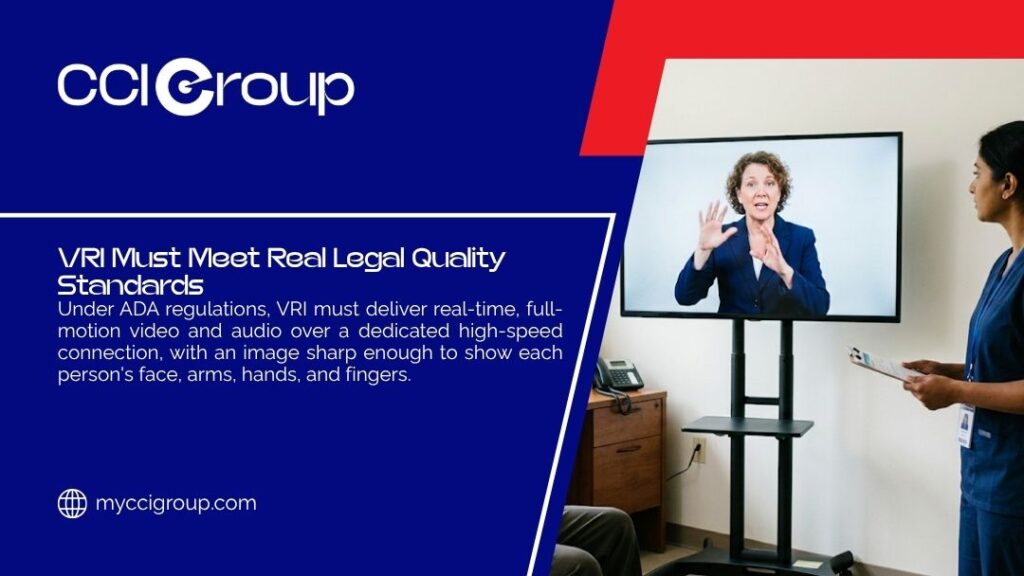
The ADA also matters when Deaf and hard-of-hearing access is involved. DOJ guidance says covered entities must communicate effectively with people who have communication disabilities. That is why VRI quality matters. A blurry screen, weak connection, poor audio, or unqualified interpreter can defeat the whole purpose.
VRI cost is important, but the real value is mission-critical communication. When someone needs help in a legal, medical, educational, financial, public-service, or emergency setting, language access can affect outcomes. That is why businesses should look at remote interpreting pricing through the lens of risk, access, and public trust.
For ASL, CART, captioning, and other accessibility needs, CCI Group’s sign language and accessibility services give organizations a clearer path than treating accessibility as an afterthought.
The problem with choosing the cheapest VRI provider
A low quote can look good in a spreadsheet. But here is where businesses get burned: the cheapest provider may not have the right interpreter available, may round up aggressively, may add platform fees, may lack reporting, or may not support ASL, legal, medical, or rare-language requests well.
A low per-minute rate also says nothing about connection speed. If staff wait too long, the “cheap” service slows the whole team. It says nothing about interpreter quality. It says nothing about security. It says nothing about whether the provider can help during a public meeting, emergency, or sensitive HR conversation.
Cheap VRI can work for low-risk, routine conversations. But when the conversation involves consent, rights, money, safety, discipline, legal documents, medical instructions, or access for Deaf and hard-of-hearing people, the lowest rate should not be the deciding factor.
A better buying question is this: does the provider reduce risk while making communication easier for staff and the person they serve? If yes, the rate has context. If no, even a low price can cost too much.
Who pays for interpreter services?
In many business settings, the organization pays for interpreter services because the organization is responsible for serving the customer, patient, student, employee, resident, or client in a way they can understand. The details depend on the industry, contract, setting, law, and country.
In healthcare, government, education, and many public-facing services, interpreter access can connect directly to civil rights, disability access, or language access obligations. In private business settings, payment may be tied to customer service standards, risk management, HR policy, or contractual duty.
If the person needs an interpreter to access your service, shifting the cost to that person can create trust and compliance problems. It can also feel unfair. After all, a business does not usually charge customers for a wheelchair ramp, captions on a required video, or a compliant intake process.
When Deaf and hard-of-hearing access is involved, the stakes rise. Businesses should consider whether they need ASL, CART captioning, VRI, onsite interpreters, or other accessibility support.
How much are translation services compared with VRI?
People often mix up interpreting and translation, but they are different services. Interpreters work with spoken or signed language in real time. Translators work with written content. So when someone asks how much are translation services cost, the answer usually depends on word count, language pair, formatting, certification, turnaround time, and subject matter.
Translation services cost per hour may apply for editing, desktop publishing, localization, or review work. Many document translation projects are priced per word or per page. Certified translation can cost more when the document needs a signed certificate, notarization, or use with a court, school, immigration office, or agency.
VRI is different. It is live. You pay for access to an interpreter during the conversation. If your business has both live conversations and written forms, you may need a blended language access plan. A law firm, for instance, may need remote video interpretation for client meetings and certified translation for evidence, contracts, birth certificates, or court documents.
Businesses that serve multilingual clients may also need notarized or apostilled documents. In those cases, remote online notarization and apostille support can sit alongside interpreting and translation, especially when a signer needs language support during a legal or financial transaction.
How to choose video remote interpreting providers
Price matters. Of course it does. But choosing video remote interpreting providers by the lowest rate alone is a risky bet. A cheap session can become costly if the interpreter lacks the right credentials, the video freezes, the platform is clumsy, or the provider cannot support the language you need at the moment you need it.
A serious provider should be able to explain its interpreter screening process, language coverage, average connection time, security practices, reporting tools, cancellation rules, minimums, and escalation process. Those questions get stricter under a public contract, and our guide on how government buyers should evaluate interpreting providers lays out the compliance and documentation standards that apply. If you want a full checklist for evaluating a language services vendor before you sign, walk through the credentials, security, and service-level questions that separate a reliable partner from a cheap rate. It should also tell you whether rates vary by language, time of day, certification level, ASL, or industry.
Ask how the provider handles rare languages. Ask whether it supports video remote interpretation services for ASL and spoken languages. Ask whether it can provide an over-the-phone interpreter when video is unnecessary. Ask whether it supports scheduled VRI, on-demand VRI, RSI, and onsite interpreting when the situation calls for it.
You should also ask about training. A great platform still fails if staff does not know when to use it. Front desk teams, call center agents, HR staff, clinicians, case managers, and legal assistants need clear internal rules. When should they use phone? When should they use video? When should they request an in person interpreter? When should they stop and escalate?
For public agencies, school systems, and eligible organizations, procurement can also matter. CCI Group’s Sourcewell language services contract may help public-sector buyers streamline access to language services without starting from scratch.

Questions to ask before you sign a VRI contract
Before your business signs, ask for the real rate card. Not the prettiest number on the website. The real one. You want to know the rate by language, service type, time of day, minimum charge, cancellation window, platform fee, setup fee, and any charge for extra participants. When you are comparing several vendors at once, building a complete interpreter services RFP forces every provider to answer those same rate questions in a directly comparable format.
Ask whether telephone interpreting rates differ from VRI. Ask whether over the phone interpretation rates are billed in one-minute increments or rounded up. Ask whether video remote interpreting cost changes for ASL. Ask whether legal, medical, or certified interpreters cost more. Once the rate card is clear, turn to the SLAs a language services contract should cover, including connection times, interpreter qualifications, uptime, and remedies when the vendor misses. Ask whether recordings, reports, or integrations carry added fees.
Ask what happens when a language is unavailable. Do you wait? Do you switch to phone? Does the provider call in a coordinator? Do they charge while they search? These tiny details matter on a busy day.
Ask about data and privacy. If your business works in healthcare, education, finance, law, insurance, government, or HR, the platform cannot be casual. It should support secure access, confidentiality, and appropriate records. A remote video interpretation tool may look like a normal call, but the information shared inside it can be sensitive.
Ask about people, too. How much does an interpreter cost? That is not the same as how much an interpreter makes per hour. The business rate includes the interpreter, platform, scheduling, quality control, management, support, compliance, and vendor margin. A fair provider should be able to explain the value without dodging the question.
FAQ about VRI cost for businesses
How much does VRI cost per minute?
Most businesses should expect VRI to cost about $2 to $5 per minute for on-demand service. The rate may be higher for ASL, rare languages, legal sessions, medical settings, after-hours calls, or urgent coverage.
Is VRI cheaper than an in-person interpreter?
Usually, yes. VRI often costs less than an in person interpreter because it avoids travel time, mileage, parking, and longer minimum bookings. On-site interpreting can still be the better choice for complex court, medical, public-event, or high-stakes sessions.
Do businesses have to pay for interpreter services?
Often, the organization pays because it is responsible for providing clear access to its service, program, or workplace process. The exact duty depends on the industry, legal setting, funding, contract, and access need.
Is video remote interpretation available for ASL?
Yes. VRI is commonly used for ASL when a Deaf or hard-of-hearing person needs real-time visual communication. Quality matters here. The screen, connection, camera angle, interpreter skill, and setting must support effective communication.
What affects video remote interpreting rates?
The biggest factors are language, interpreter credentials, session length, urgency, time of day, subject matter, ASL needs, platform requirements, reporting, security, and monthly volume.
Can VRI be used for legal or medical appointments?
Yes, but the provider should match the interpreter to the setting. Legal and medical conversations often need trained interpreters with the right vocabulary, ethics, confidentiality practices, and experience.
Is VRI worth the cost for a business?
For many organizations, yes. VRI is worth the cost when a visual connection improves clarity, trust, access, or compliance. It is especially useful for businesses that serve customers, patients, students, employees, or residents across language lines and cannot wait days for onsite support.
VRI is not always the cheapest option. A short phone call may cost less. But cost is not the only measure. When a conversation is sensitive, complex, visual, or tied to access rights, video can prevent confusion that a phone call might miss.
If your business is comparing interpreter cost, over the phone interpreter rates, video remote interpreting platform options, and on-site support, start with your real use cases. List the languages your team sees most often. Estimate monthly minutes. Separate quick calls from sensitive meetings. Then choose a provider that can support the full picture, not just the lowest per-minute number.
For organizations that need dependable language access across phone, video, onsite, ASL, translation, accessibility, and public-sector communication, connect with CCI Group to request a quote built around your actual business needs.