

Two providers quote the same per-word rate. Only one commits in writing to when the work arrives, how accurate it has to be, and what happens when it isn’t. That written commitment is the service level agreement (SLA), the difference between a vague promise and an accountable partnership. Use the checklist below to review any language services contract before you sign.
What an SLA is, and the SLA language in a contract
An SLA is the section of a contract that defines the service being delivered, the measurable standards the provider must hit, and the metrics used to prove they hit them. That is the SLA meaning in business: not a mission statement, but an enforceable performance definition. As the University of California, Irvine Office of Research frames it, an SLA documents the specific services, the expected level of service, and how performance is monitored.
That distinction is the whole point. Marketing language, “industry-leading quality,” “fast turnaround”, commits a provider to nothing. SLA language, the specific enforceable clauses, attaches a number, a method of measurement, and a consequence to each promise. Good SLAs are written so every stakeholder can understand them, not buried in jargon only the vendor’s legal team can parse.
Marketing language commits a provider to nothing. SLA language attaches a number, a method of measurement, and a consequence to each promise.
The three types of SLAs (and which one a language contract uses)
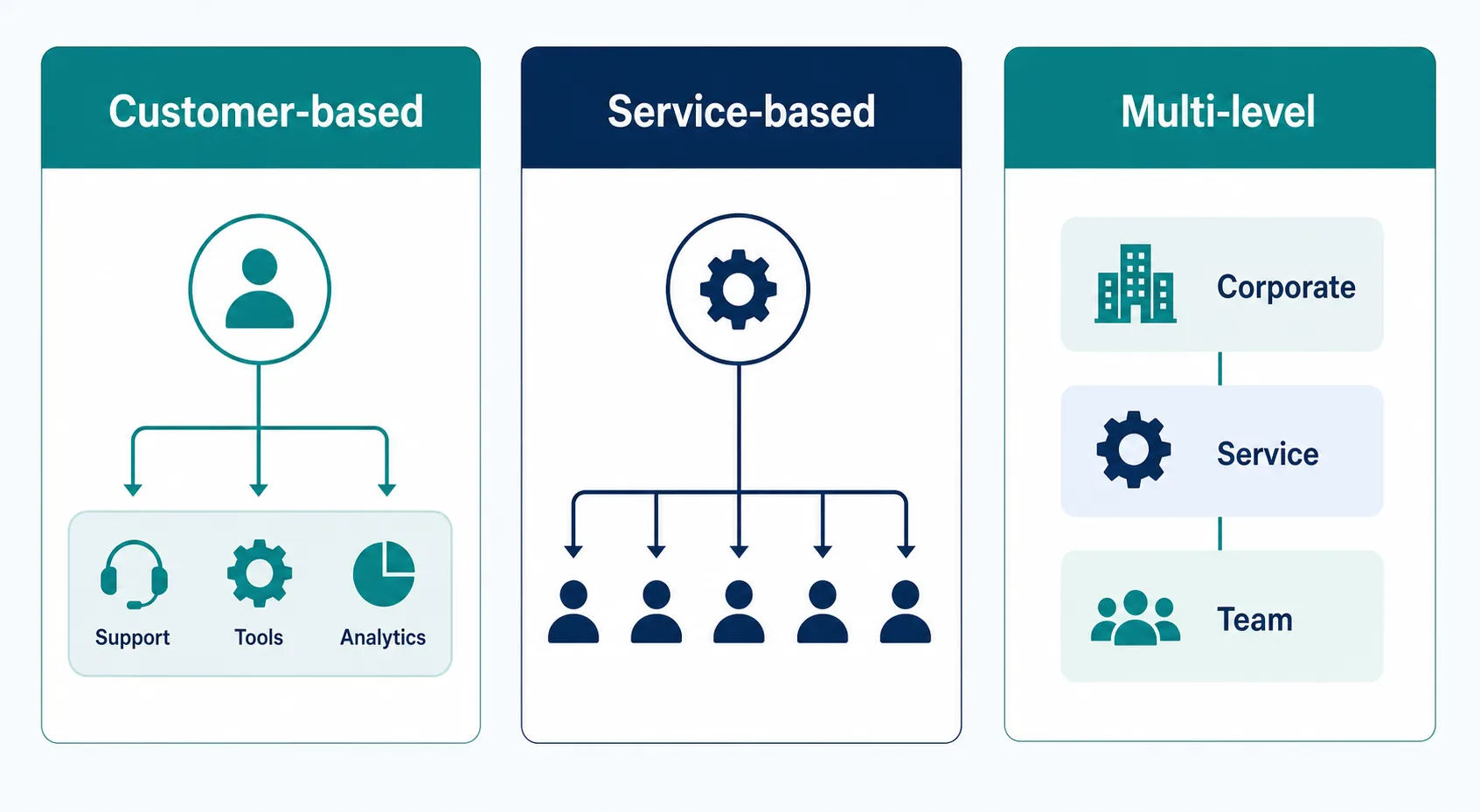
Most agreements fall into one of three structures.
Customer-based SLA
One agreement covering everything a single client buys, useful when a business purchases bundled translation and interpreting under a single set of terms.
Service-based SLA
Identical terms for every customer of one service, such as a provider’s standard over-the-phone interpreting SLA.
Multi-level SLA
Layered terms, a corporate level, a service level, and an individual or department level, best for large or multi-department buyers with varied needs. Academic work on SLAs, including a taxonomy review in ScienceDirect, maps these categories and how their obligations nest.
Most translations for business buyers land on a customer-based or multi-level structure, because they rarely need just one language service in isolation.
The core SLAs every language services contract should include
This is the checklist. If a clause below is missing or unmeasurable, flag it.
Turnaround time and delivery commitments
Define standard versus rush timelines, priority processing, and whether coverage is business-hours or 24/7. Spell out how volume affects deadlines and, critically, what “on time” means and how it’s tracked, such as a delivery timestamp in a project system.
Quality standards and accuracy
Name a defined quality benchmark rather than “high quality.” That can mean adherence to a recognized translation quality standard, defined error categories, revision and re-do rights, and a documented sign-off process. High-stakes work such as Spanish legal translation may warrant stricter accuracy tiers plus explicit certification or notarization terms. Government procurement guidance, including the Ohio Office of Budget and Management’s Contract Performance and Service Level Agreements, stresses that performance standards must be specific and measurable to be enforceable.
Availability and responsiveness (critical for interpreting)
For OPI interpretation, over-the-phone interpreting, where an interpreter joins a live call, and video interpreting, connection reliability matters far more than turnaround. Define average speed-of-answer, connection success rate, the range of languages available on demand, and hours of coverage. This is what buyers comparing interpreting providers are really evaluating: can the provider actually answer, in the language needed, fast enough. The OPI interpreter meaning here is a live human linguist reachable in seconds, and the SLA should say how many seconds.
Confidentiality, data security, and compliance
Include NDA and data-handling clauses, secure file transfer, and regulatory compliance where relevant, HIPAA for healthcare content, applicable data-privacy law elsewhere. This is where the concept of a Security SLA (SecSLA) applies: a dedicated layer of security-specific commitments. Research such as this Springer study on SLAs and Security SLAs treats security guarantees as their own measurable dimension, distinct from general service quality.
Roles, responsibilities, and scope
Clarify what the client must supply, reference material, glossaries, source-file context, versus what the provider owns. Clear scope boundaries prevent most disputes.
Reporting, review cadence, and points of contact
State how performance is reported, how often it’s reviewed, the escalation path, and named contacts on both sides.
Remedies, what happens if SLA targets are not met
An SLA without consequences is a wish list. Spell out remedies: service credits, penalties, formal escalation, and termination rights for repeated breach. Distinguish penalty structures, where the provider loses money for missing a target, from incentive structures, where the provider earns more for exceeding one. Whichever you choose, remedies must be measurable and proportionate to the impact of the miss.
Beyond $ credits, you should also have language that discusses termination scenarios for not meeting certain outcomes, or consecutive SLA …
A simple service level agreement example (what the clauses look like)
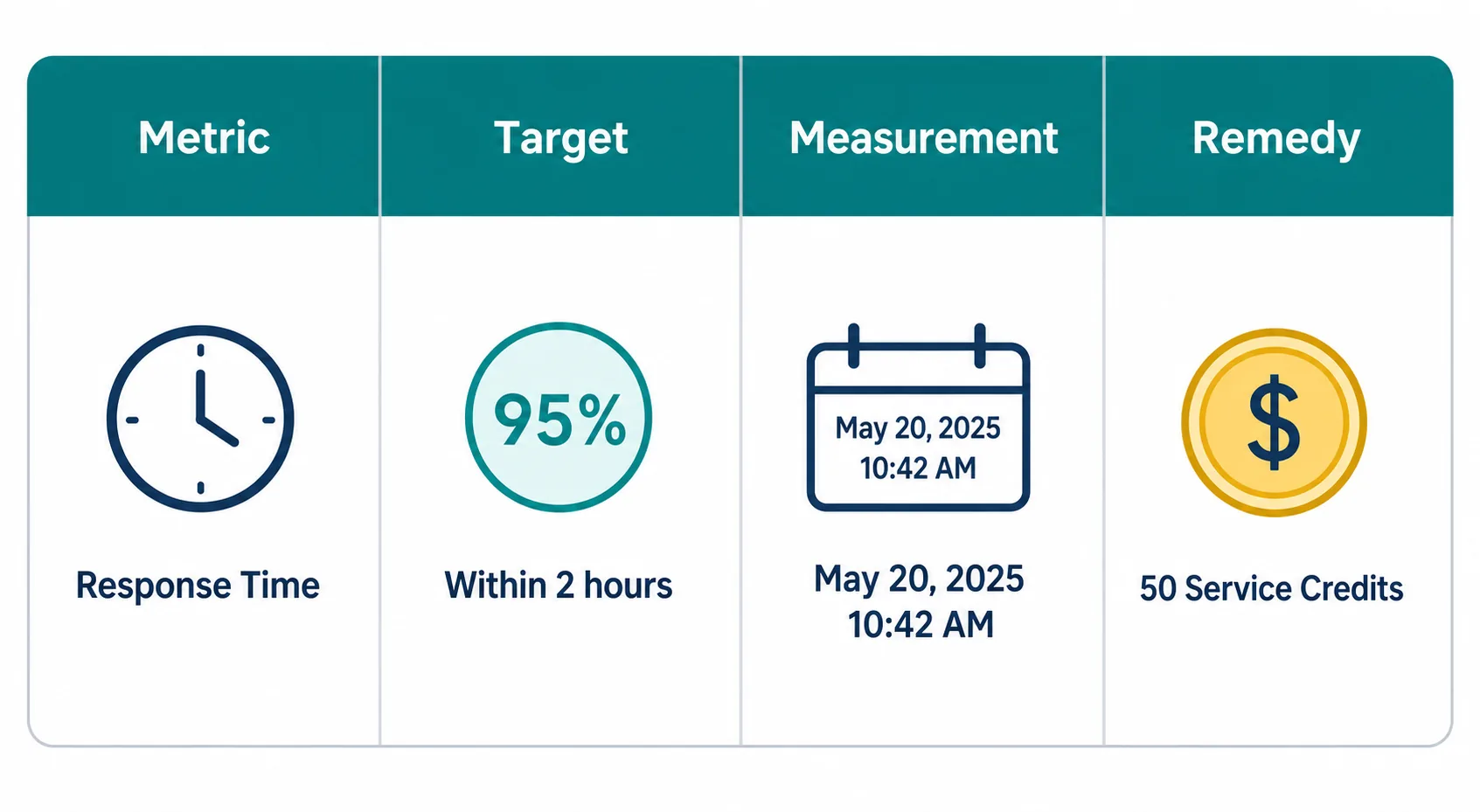
A workable Service Level Agreement example ties four columns together, metric, target, measurement, and remedy:
| Metric | Target | Measurement | Remedy |
|---|---|---|---|
| Standard translation turnaround | 98% delivered within 2 business days | Timestamps in project system | 5% invoice credit if missed |
| OPI speed-of-answer | Average under 30 seconds | Call-platform logs | Escalation review at monthly meeting |
| Accuracy | Error rate below defined threshold | Post-delivery QA sample | Free re-do of affected content |
| Confidentiality | Zero unauthorized disclosures | Incident reporting | Contractual penalty per breach |
There is no single “standard” SLA contract. The right one is tailored to the service type and the risk involved, a marketing brochure and a court document don’t belong under the same accuracy tier.
Why interpreting and translation need different SLAs
Contracts often lump everything under one “translation SLA,” but the two services fail in different ways and should be measured differently:
| Real-time interpreting | Document translation |
|---|---|
| Speed-of-answer | Turnaround time |
| Connection / video quality | Formatting fidelity |
| Language availability on demand | Terminology consistency |
| Uptime and hours of coverage | Accuracy and QA sampling |
If you buy both, insist the contract measures both, separately.
SLA red flags to watch for before you sign
- “Best efforts” language with no defined target
- A target with no stated measurement method
- Targets with no remedy attached
- Open-ended scope that invites scope creep
- No confidentiality or data-security terms
- No named quality standard for accuracy
Any one of these turns a checklist item back into a marketing promise.
Frequently asked questions
What is the SLA language in a contract?
What should an SLA include?
What is the standard SLA contract?
What are the three types of service level agreements?
What does OPI interpretation mean?
The right SLA turns a vague vendor promise into an accountable, measurable partnership. A provider like MyCCI Group that delivers translation, OPI and video interpreting, and certified or legal translation should be willing to put each of these terms, turnaround, quality, availability, security, and remedies, in writing.