

Translation carries meaning from one language into another. Localization adapts the whole experience (wording plus formats, visuals, layout, and function) so the content feels built for one specific place.
The two are not rivals. Translation sits inside localization. The practical question is narrower than the vocabulary suggests: does this content need to stay faithful to a source document, or work for an audience in a particular place? A deposition transcript is the first. A benefits enrolment website is the second.
What is translation?
Translation renders written source content into a target language while preserving meaning, tone, and intent. The primary unit of work is the text. Depending on the project requirements, the deliverable may preserve the source structure, formatting, and level of detail, while accuracy is evaluated against the source content. Learn more about CCI Group’s professional translation services.
Professional translation may follow a TEP workflow: translation, editing, and proofreading, in which another qualified linguist reviews the work against the source before delivery. Glossaries can also help keep key terms consistent across related documents.
Certified translation is the version courts, immigration offices, licensing boards, and universities usually ask for: the translated document arrives with a signed statement attesting that it is complete and accurate.
Raw machine-translated output should not be treated as a final deliverable for legal, medical, safety-critical, or other high-risk content. These materials require an appropriately qualified human review process before use.
What is localization?
Localization adapts content for a locale, meaning a language plus a region. Mexican Spanish and Castilian Spanish are different targets. So are US English and Canadian English. Same language, different money, spelling, agencies, holidays, and habits.
Localisation is exactly what it sounds like, you not only translate words but context, references, etc. A perfect localisation would be able to …Read on Reddit ↗
Localization includes translation, then goes further into formatting, culture, design, and function. Planning for it early is cheaper than retrofitting: content built with flexible layouts, editable text, and wording kept separate from code adapts without a rebuild.
Typical localization work: websites, apps, e-learning and staff training, subtitles and captions, public-facing forms, signage and community outreach.
Localization vs translation: side-by-side differences
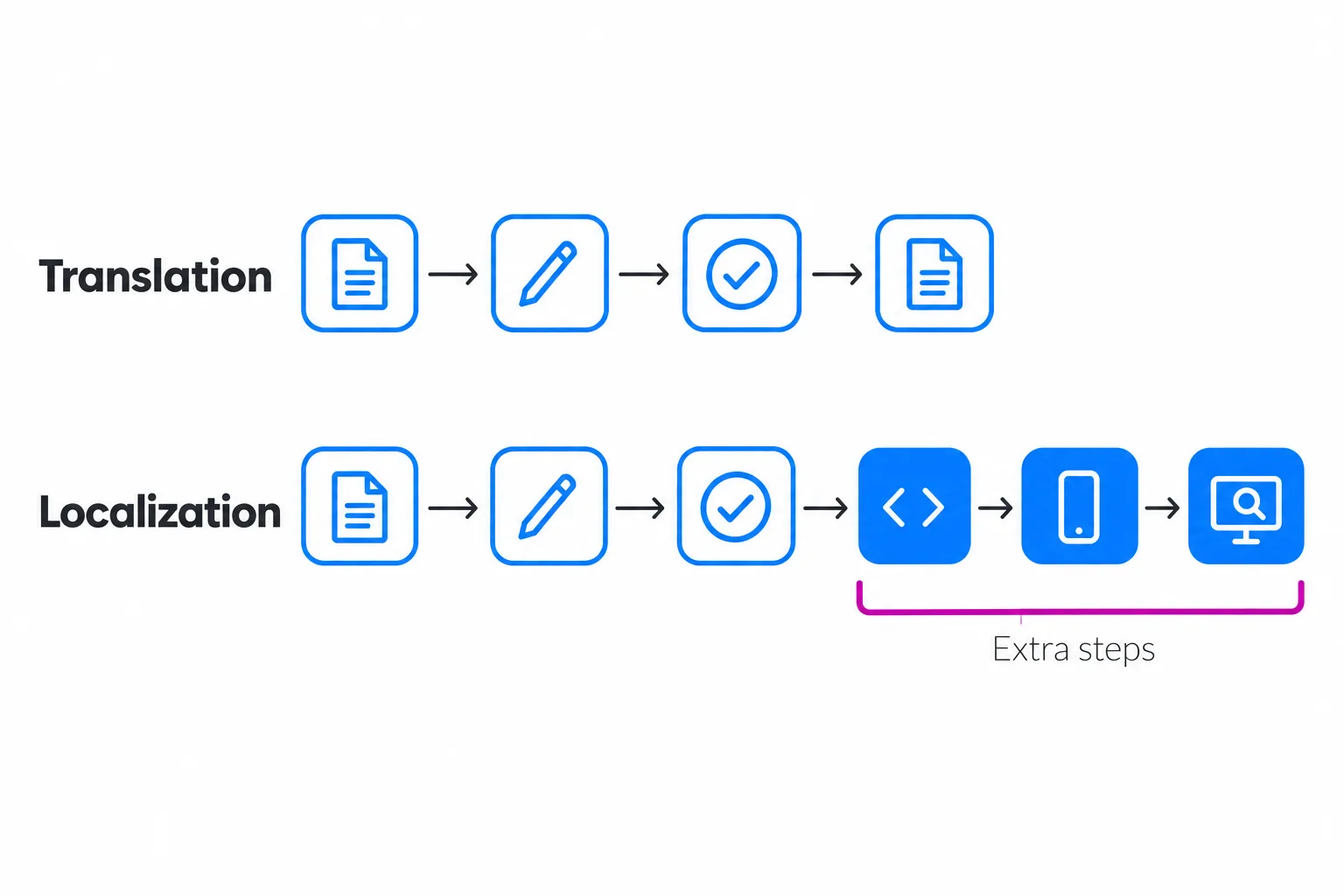
The main difference between translation and localization is scope. Translation converts written meaning from one language into another. Localization includes translation but also adapts formats, imagery, design, cultural references, and functionality for a specific locale.
| Translation | Localization | |
|---|---|---|
| Scope | Text only | Text, format, visuals, layout, function |
| Unit of work | The document | The asset and the experience around it |
| “Correct” means | Faithful to the source | Feels native to the audience |
| Inputs needed | The source file | Source files, design or text files, style guide, market brief |
| Review method | Linguistic revision and proofreading | Revision plus in-context or on-device review |
| Typical timeline | Shorter, driven by word count | Longer, driven by asset count and review rounds |
| Best for | Records, filings, evidence, certification | Websites, apps, training, outreach |
Cost follows scope. Localization touches more file types and more people, so it usually costs more per asset than translating the same words. Neither is a rate you can guess from word count alone.
How the workflows differ
A translation project typically moves through source-file preparation, translation, editing, proofreading, and delivery. A localization project adds market research, asset preparation, technical implementation, in-context review, and functional or linguistic quality assurance. The exact workflow depends on the content, platform, target locales, and risk level.
What localization adds beyond the words
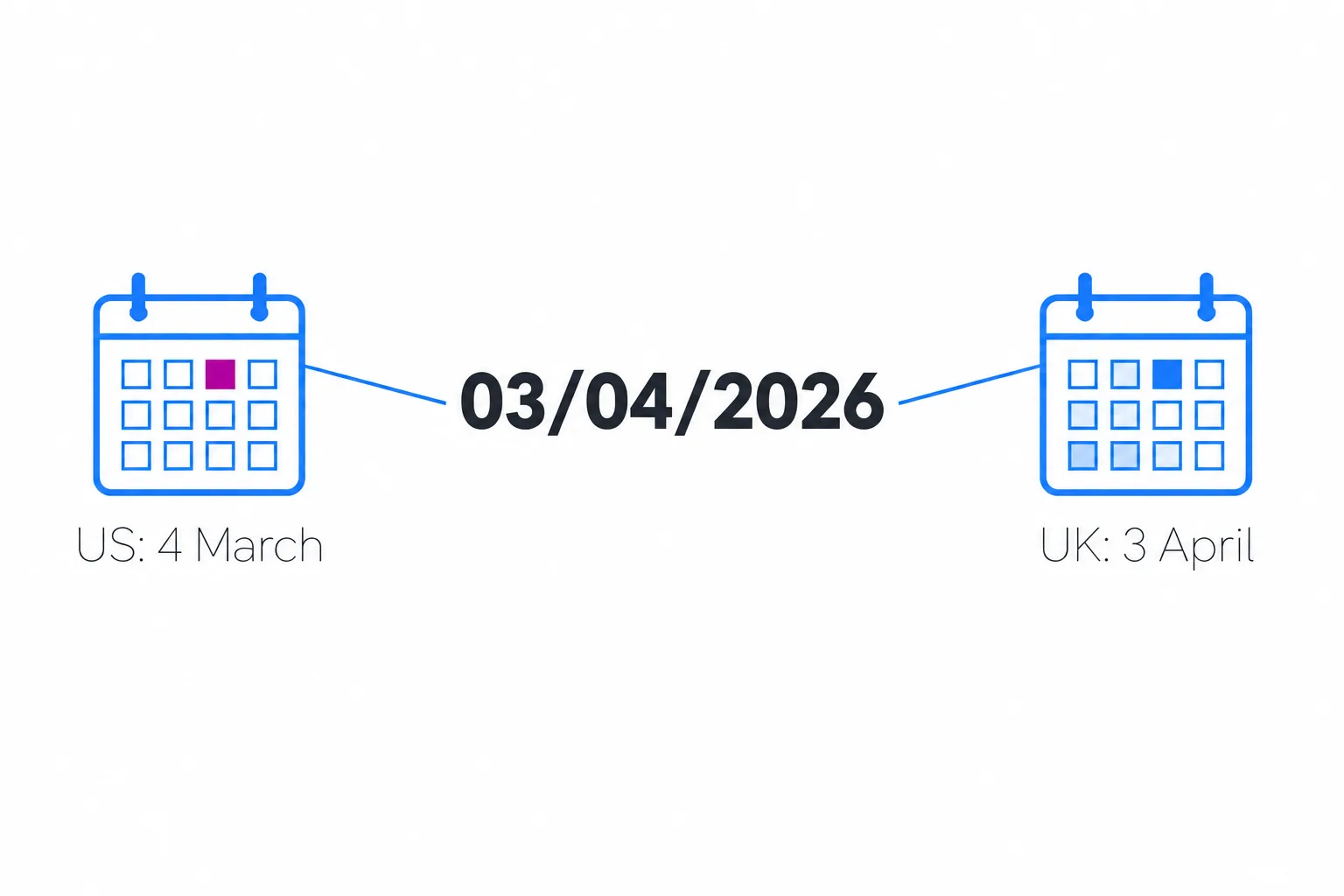
Formatting: dates, currency, units, addresses
03/04/2026 reads as 3 April in most of the world and 4 March in the United States. Put that on an appointment letter, a permit deadline, or a court date, and someone misses it.
Decimal and thousands separators swap places between locales. So do currency symbols, units of measurement, paper sizes, time zones, and the 12- versus 24-hour clock. Forms carry their own assumptions: postcode fields, phone number layouts, and name fields that break when someone uses two surnames. These are conventions of the locale, not a translator’s preference.
Culture: idioms, imagery and examples
Sports metaphors and holiday references rarely survive a border. Nor do some gestures, colour associations or stock photos. Localization swaps a US grade level for the local equivalent, names the agency the reader actually deals with, and picks the right level of formality (usted or tú changes the tone of an entire letter).
In healthcare, courts, emergency communications, and domestic violence services, this stops being a style question. Wrong register or wrong terminology costs trust at the moment you need it most.
Design and layout: text expansion and reading direction
Text translated out of English often runs longer, which breaks buttons, navigation bars, table cells, and PDF templates sized for the original. Arabic, Hebrew, Persian, and Urdu read right to left, so those versions need the layout and interface mirrored, not just the text swapped in.
Fonts matter too: the original typeface may not support the script or diacritics you need. For video, subtitle reading speed, character limits and timing all shift with the language.
Function, accessibility and compliance
Language attributes and metadata tell screen readers how to pronounce a page. Search, sorting and form validation often assume English input and quietly reject valid names or addresses. Each language version needs its own URL, navigation and a switcher people can find. Standard language-region identifiers help digital systems identify the intended language and locale.
Accessibility applies to every language version, not only the English one. So do jurisdiction-specific notices, disclaimers and consent wording, which are legal content and should be reviewed as such.
Translation vs localization examples
- Enrolment form. Translation renders the questions. Localization fixes the date order, rebuilds the address block, and replaces the reference to a US-only ID document.
- Safety training for a construction crew. Translation delivers the words. Localization uses the tool names and permit terminology the crew actually hears on site, in the regional Spanish they speak.
- Public agency website. Translation covers page copy. Localization covers navigation, attached PDFs, forms, text baked into images, and the language switcher.
- Marketing tagline. Translation is literal; localization reworks the idiom; transcreation rebuilds the line from the idea up.
- Court transcript. Translation, full stop. Nothing gets adapted.
When translation is the right choice
Choose straight translation when deviating from the source creates exposure: contracts, filings, depositions, witness statements, police reports, medical records, regulatory submissions, technical specifications, financial statements. The same applies to anything needing certification or a statement of accuracy.
Sensitive files bring a second requirement. For legal, healthcare, and public-safety materials, ask how linguists are selected, how confidential files are protected, and which security or compliance requirements apply to the specific project.
When localization is essential
Choose localization when the content has to persuade, instruct, or trigger an action: websites, apps, onboarding, e-learning, outreach campaigns. Comprehension is the goal, not literal equivalence.
It also applies to multimedia (subtitling, captioning, voiceover, transcription), to distinct regional audiences inside the same language, and to indigenous and less commonly served languages, where community norms carry as much weight as vocabulary.
Where transcreation fits
Transcreation rebuilds a message from its intent and often shares no wording with the source. Reserve it for taglines, campaign concepts, and brand voice. Read the three as a spectrum of creative freedom: translation, then localization, then transcreation.
Where internationalization fits
Internationalization prepares a website, app, or other digital product for localization before individual language versions are created. It may involve separating text from code, supporting flexible layouts, enabling locale-specific formats, and preparing the interface for right-to-left languages. Translation changes the language, localization adapts the product for a locale, and internationalization makes that adaptation technically easier.
The category people forget: interpretation
Translation and localization are written. Interpretation is spoken and live. CCI Group also provides phone, video, and on-site interpreting services for real-time communication.
- Over-the-phone interpretation (OPI): an interpreter joins your call on demand. Best for short, unscheduled encounters and after-hours coverage.
- Video remote interpretation (VRI): adds visual cues, useful for ASL and for anything involving a document or a device on screen.
- On-site interpretation: consecutive, simultaneous, and ASL services for court proceedings, medical appointments, IEP meetings, emergency response, and community sessions. CART captioning is a related accessibility service rather than a form of interpretation.
CCI Group offers interpreting support across 350+ languages, with 24/7/365 access available through its interpreting solutions. Confirm the appropriate channel and availability for the required language when scoping the service.
How to decide: five questions
1. Is this a document of record, or an experience someone interacts with? 2. Does anything in it depend on place: dates, currency, units, laws, agencies, holidays? 3. Does it contain images, layout, video, or interface elements, not just text? 4. What is the exact locale, not just the language? 5. Does the outcome need certification, or does it need engagement?
Mostly document-of-record answers point to translation. Mostly experience answers point to localization. Most organisations need both, on different assets.
What to ask a language partner before you start
- Who reviews the work, and how? Look for a documented TEP process and a second linguist.
- How is terminology captured and reused across projects?
- Do they work with your source and design files, or only return loose text?
- How is sensitive material secured, and who has access?
- Can one partner cover written translation, localization, and live interpretation, so you are not stitching vendors together?
- For public agencies: can an eligible cooperative purchasing contract help streamline the required procurement process? CCI Group is an awarded vendor through Sourcewell Contract #081225-IDY, with a listed maturity date of December 2, 2029. Eligible organizations should confirm their participation requirements and applicable procurement rules.
Ask whether your engagement includes a dedicated program manager who can learn your workflow, coordinate requests, and reduce administrative work for your staff.
Frequently asked questions
Related readingTagalog / Filipino Localization and Multimedia Services | CCI GroupRead the guide →Frequently asked questions
Can you give me an example of localization in translation?
Is it localisation or localization?
What exactly is localization?
Is localization more expensive than translation?
Translation or localization? Scope the right solution
Match the method to what the content has to do. If it has to hold up as a record, translate it. If it has to work for someone in another place, localise it.
Tell us the content type, the target locale, and the deadline, and we will scope the appropriate translation or localization solution. [Call (727) 657-3167](tel:\(727\)%20657-3167) or, if your organization is eligible, explore CCI Group’s Sourcewell Contract #081225-IDY to help streamline procurement in accordance with your applicable requirements. We handle the details so your staff can stay on the mission.