

If you have a filing deadline, an immigration packet, or a court date coming up, “it depends” is not a useful answer. You need an estimate for your actual documents and a clear explanation of what that estimate includes.
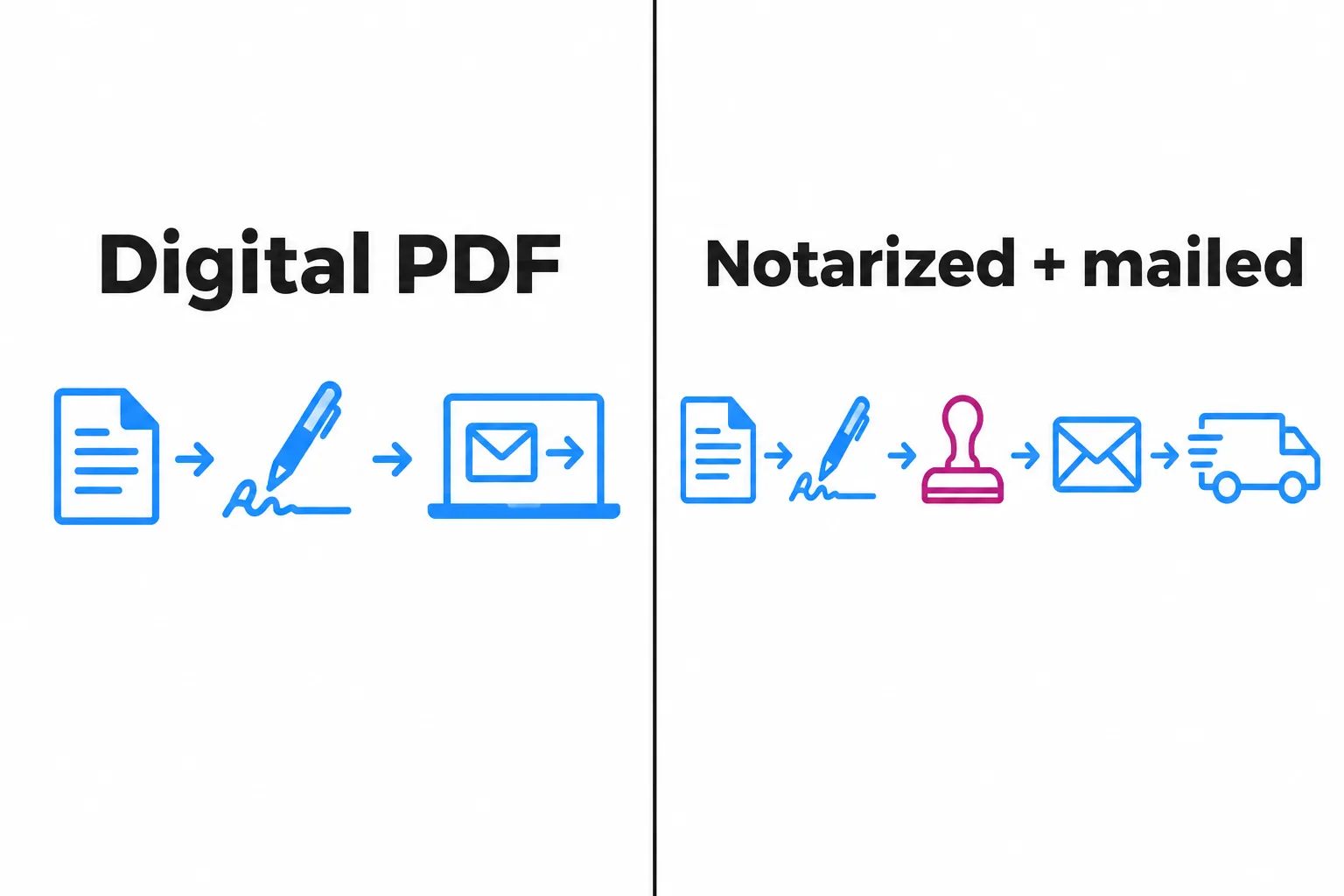
A short digital translation and a mailed, notarized document packet have different delivery schedules. Confirm which one your recipient needs before you order.
How Long Does Certified Translation Take at CCI Group?
CCI Group’s certified document translation services list standard delivery within 24–48 hours, with expedited same-day options for urgent matters. Confirm the applicable delivery date after the team reviews your files, language pair, and recipient requirements.
That is CCI’s published service information, checked October 26, 2026. It is not a market-wide average or a guarantee that every document qualifies.
| Your request | What to confirm before ordering |
|---|---|
| Short, clear certificate or diploma | Whether the standard window covers your language pair and final signed PDF |
| Dense transcript, contract or court filing | Word count, formatting and specialist-review time |
| Large batch or mixed case file | A project schedule, document list and any staged deliveries |
| Notarized, authenticated or mailed copies | Separate processing and transit time beyond translation |
Ask whether the quoted hours are calendar hours or business hours. Also confirm weekends, holidays, the time zone, and any submission cutoff.
When Does the Turnaround Clock Actually Start?
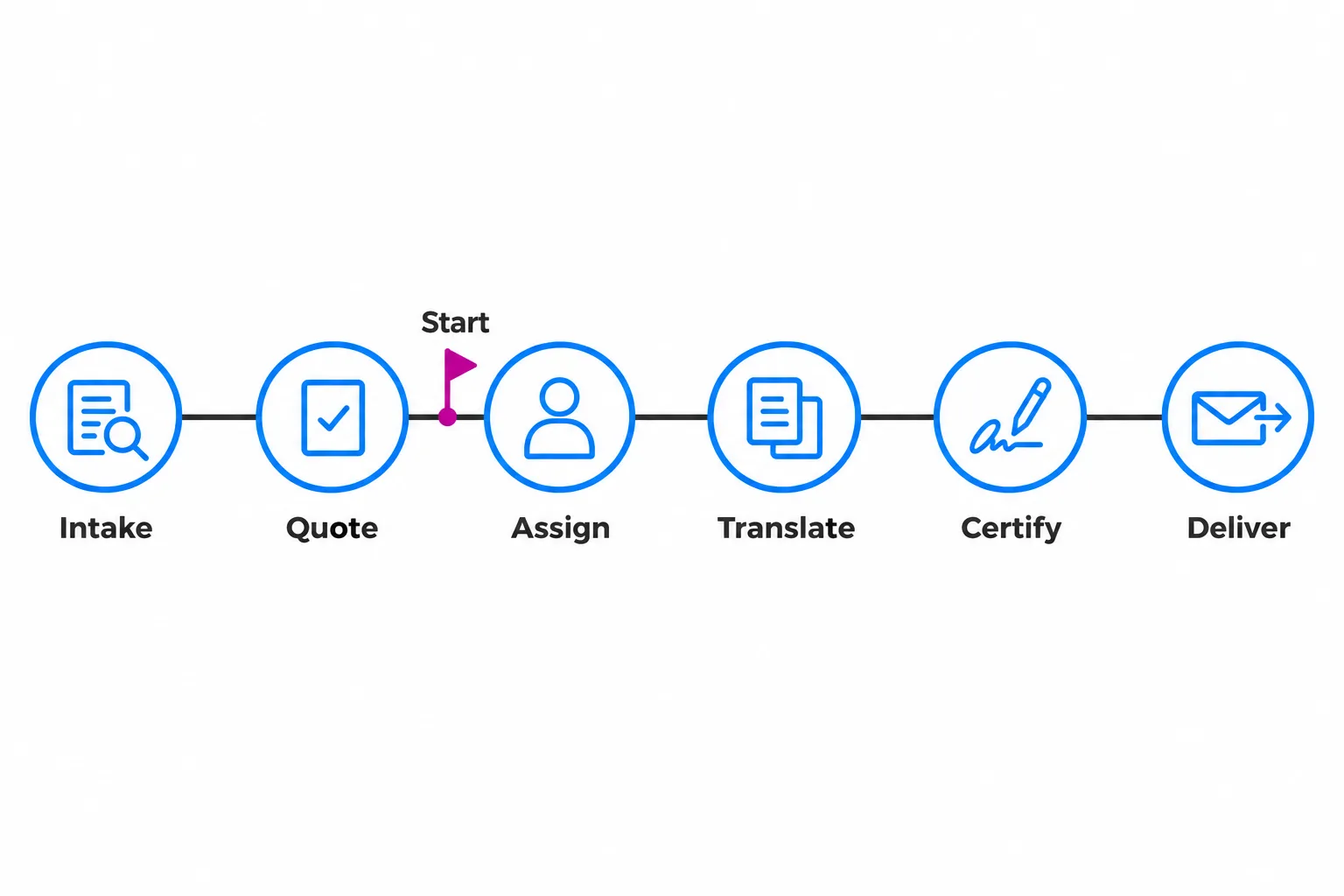
The clock starts at the point specified in your quote or order confirmation. Uploading a file or sending an enquiry may happen before the provider has reviewed and accepted the work.
A certified translation moves through a few stages:
- Intake and legibility check: someone confirms every page is present and readable.
- Quote and approval: you confirm scope, price, and deadline.
- Translator assignment: a qualified linguist for your language pair and subject is matched.
- Translation and review: The document is translated and checked through the agreed review process. Ask whether separate editing or proofreading is included.
- Certification: A signed statement attesting to completeness and accuracy is attached.
- Delivery: Confirm whether this means a review draft, the final signed translation, dispatch of printed copies, or arrival at your address.
Missing pages, unclear names, approval requests or payment requirements can hold an order before or during production. Ask which outstanding items must be resolved before the delivery estimate applies.
For example, a Friday-evening enquiry may not be reviewed until Monday. Rather than calculating the deadline from the enquiry time, ask for the exact delivery date and time in writing.
Does Certification Add Another Approval Stage?
For a U.S. certified translation, certification normally involves a statement accompanying the finished translation. It is not automatically a separate government approval process.
The American Translators Association’s certified translation explanation distinguishes a certified translation from a translator’s professional certification. A translator does not necessarily need an ATA credential to provide a certified translation, although the recipient may specify qualifications or wording.
Confirm the certification requirements before translation begins. Adding a missing statement, changing its wording, or arranging an additional signature after delivery can create avoidable rework.
What Makes Certified Translation Take Longer
Document Type, Length, and Formatting
Word count and density matter more than page count. One page of a dense contract can hold more text than five pages of certificates. Ask the provider to count and assess the actual files rather than relying on the number of scanned pages alone.
Tables, handwriting, stamps, seals and margin notes need careful handling. A complete translation should account for relevant visible content; unclear text should be flagged rather than guessed.
Legal, medical and technical material may also require terminology research and subject-specific review. A document’s title alone does not establish its production time.
Language Pair Availability
Translator availability depends on the source and target languages, subject, and deadline. Do not assume a Spanish document will always be faster than Russian, or that a broad language offering guarantees immediate assignment.
Tell the provider about regional language differences or mixed-language pages. If your packet contains more than one source language, ask whether each requires a separate assignment and delivery estimate.
Legibility of the Source File
Blurry, cropped, low-resolution, or handwritten scans can pause an order before it starts. To avoid that:
- Scan documents flat, not at an angle.
- Include all document pages and any reverse-side text, stamps, or annotations. Tell the provider if the reverse side is blank.
- Make sure all stamps, seals, and signatures are fully visible.
- Send clear scans or original digital files in the requested format. A readable image is more useful than a blurred PDF.
Provide reference spellings from identity documents when requested, but do not ask the translator to change what the source says. Explain discrepancies so they can be handled appropriately.
Notarization, Apostille, and Physical Delivery
Certification, notarization, and apostille are different steps. Notarization concerns the certification of the signer’s identity or signature; it does not verify the translation’s accuracy. Order it when the receiving authority requires it.
An apostille or authentication comes from the appropriate authority and follows its own process. For applicable U.S. federal documents, check the State Department’s Office of Authentications. Do not apply its processing times to every state-issued or foreign document.
If you need help coordinating these steps, CCI’s notarization and apostille services provide a relevant next step. Confirm which document or signature needs authentication and which authority handles it.
Printed delivery adds dispatch and carrier transit time. Ask whether the quoted deadline means the package leaves the office or reaches you.
How Long Does Certified Translation Take for USCIS?
The USCIS translation rule sets content requirements, not a translation-provider deadline. Under 8 CFR 103.2(b)(3), a foreign-language document submitted to USCIS must have a full English translation, with the translator certifying completeness, accuracy, and competence to translate into English.
That provision does not itself require notarization or an ATA credential. Check the instructions for your specific filing and any request USCIS sends you. A short certificate and a lengthy supporting packet still require different scoping.
Translation delivery is also separate from USCIS processing of the application.
A fast translation does not shorten the agency’s adjudication time or establish acceptance of the filing.
Courts, universities, and other recipients can have different requirements. Share their instructions with the provider before approving the work.
Need It Faster? How Rush and Same-Day Certified Translation Work
CCI advertises expedited same-day options, but the team must confirm that your request qualifies. Ask about capacity, additional charges, the cutoff time, and the deliverables included.
A rush request should still include the required certification and agreed review. Ask what changes in the schedule rather than assuming that review can be skipped.
You can reduce avoidable delays:
- Send all pages at once.
- Provide reference name spellings and explain known discrepancies.
- State who the translation is for and your deadline upfront.
- Choose digital delivery only if your recipient accepts it.
- Respond promptly to questions and review requests.
The ability to send an enquiry outside office hours does not establish an immediate response or overnight production commitment. Confirm that separately.
Planning Certified Translations for Legal Teams and Public Agencies
For legal assistants, court staff, and agency program managers, translation time belongs on the case calendar, not squeezed in at the end. Work backward from the recipient’s deadline:
- Confirm whether the recipient needs digital files, printed copies, or additional authentication.
- Allow for any authority processing and delivery time.
- Reserve time to check names, dates, document coverage, and certification details.
- Agree on a translation completion date that leaves room for necessary corrections.
For repeat work, keep a document inventory and approved terminology references. Assign one contact to answer queries, confirm requirements, and track versions. These steps help coordination without guaranteeing faster production.
Public-sector buyers should confirm the purchasing route and contract scope with procurement staff. A translation completion estimate does not include an agency’s internal approval process unless that is expressly agreed.
Frequently Asked Questions
Related readingHow Much Does Certified Document Translation Cost Per PageRead the guide →Frequently asked questions
Can a single certified document be ready within 24 hours?
Does notarization add time?
Why was my translation delayed?
Does digital delivery mean the translation is ready to submit?
Will every agency accept the same certification?
Get a Clear Delivery Date Before You Order
Share your document type, complete files, language pair, recipient instructions, and deadline. Say whether you need notarization, apostille coordination, or printed copies.
Request a certified translation quote from CCI Group or call (727) 657-3167. Ask the team to confirm the clock start, final deliverable, and expected delivery date before you approve the project.