

You have a birth certificate, a court order, or a diploma that needs to be used in another country. The checklist says you need an apostille and a translation. Which comes first depends on the document, the office issuing the apostille, and the authority receiving your paperwork.
The Short Answer: Confirm the Requirements Before Choosing the Order
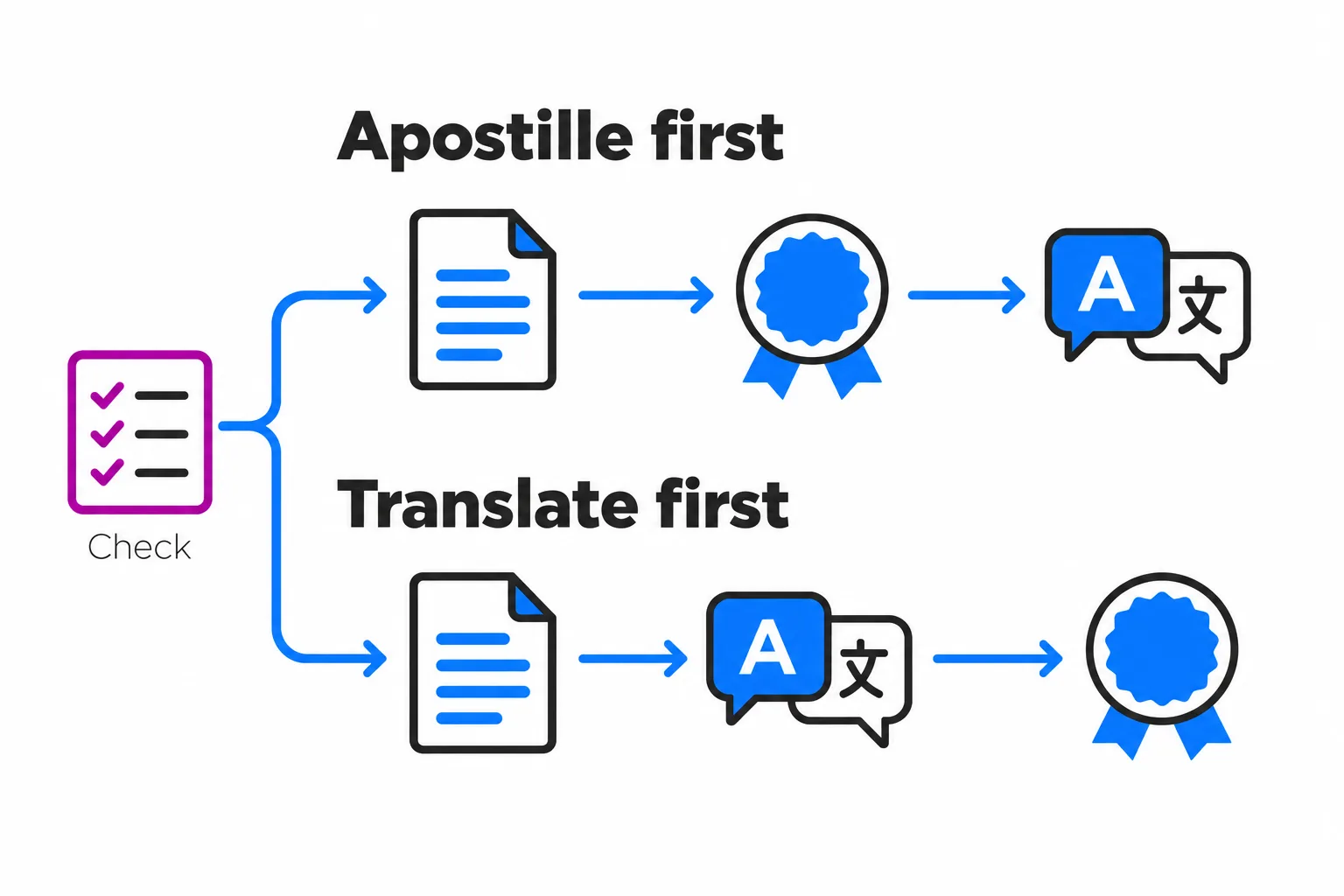
If the receiving authority wants the document and apostille translated together, obtain the apostille first, then translate the completed packet. If the issuing office requires a translation before processing, or the translation itself needs authentication, translation comes earlier. There is no single order for every filing.
Before paying for either service, get the receiving authority’s checklist and the apostille office’s preparation instructions. Check both: they address different parts of the process.
What an Apostille Certifies, and What It Does Not
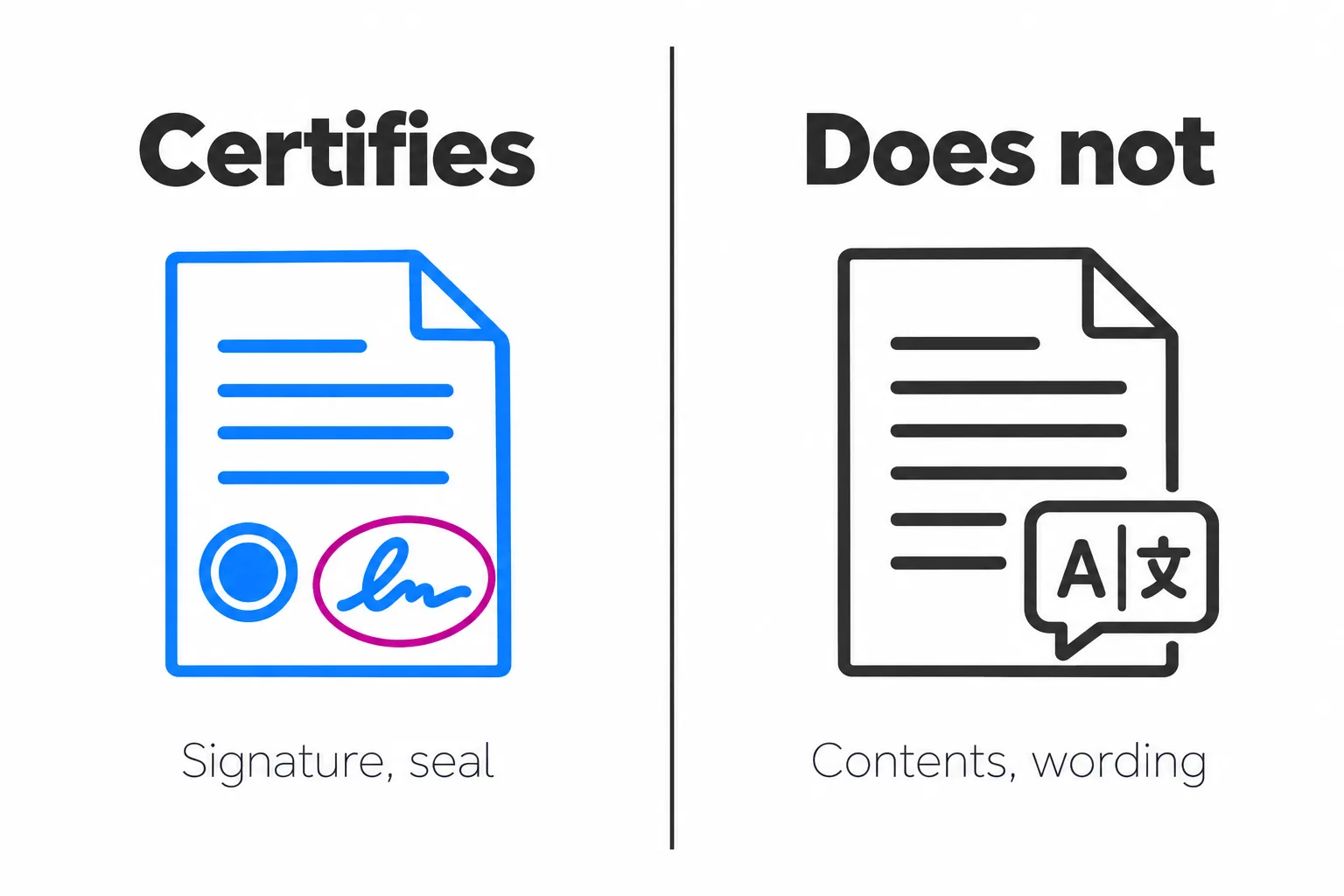
An apostille is a standardized certificate that authenticates the signature on a public document. The California Secretary of State’s apostille FAQ explains that it also confirms the signer’s official capacity and, where appropriate, the seal or stamp. It does not validate the document’s contents.
An apostille does not translate a document or assess translation accuracy. If the authenticated signature belongs to a notary, it authenticates that notarial act rather than approving the translated wording.
A certified translation includes a statement about accuracy and completeness. Notarization addresses the person signing that statement. The American Translators Association explains this distinction and recommends checking the end user’s specific requirements.
When Should You Apostille First?
Apostille first when your confirmed instructions call for authentication of the source document followed by translation of the completed set. This lets the translator work from the document with its attached certificate.
For example, if a civil registry asks for an apostilled birth certificate and a translation covering that certificate, the practical sequence is:
- Obtain the version of the birth certificate accepted by the apostille office.
- Complete any required preliminary certification and obtain the apostille.
- Have the document and apostille translated in the format the registry accepts.
This is an example of a confirmed workflow, not a rule for every birth certificate or destination.
Does the Apostille Page Need Translating Too?
Ask the receiving authority whether its translation requirement covers the apostille and other endorsements. If it does, include them in the translation order. Do not assume that every office requires the same coverage.
Give the translator clear images of every relevant page, including reverse sides, stamps, and attached certificates. If you already translated the document, ask whether the existing translation can be supplemented before paying to replace it.
When Should You Translate Before Apostille Processing?
Translation may come first when the apostille office’s procedure requires it or when a translator’s notarized certification must be authenticated.
For example, the U.S. Department of State’s federal-document preparation instructions list professional translation and notarization, when translation from English is required by the destination, before submission. The instructions separately warn against notarizing the original federal document.
Related readingCertified vs Notarized Translation: Key DifferencesRead the guide →This does not mean every U.S. document follows the federal procedure. State-issued and notarized documents have their own requirements.
Identify the correct issuing office before arranging translation or notarization.
When the Translation Itself Needs Authentication
If the receiving authority requests an apostilled translation, ask exactly which certification and signature it expects. A possible U.S. route is:
- A certified translation is prepared.
- The person signing its certification completes the required notarial act.
- The appropriate authority authenticates the notary’s signature through the required process.
That process does not automatically replace any authentication required for the source document. Equally, do not assume every packet needs two apostilles. Confirm each required document and signature separately.
What If the Authority Requires a Sworn or Approved Translator?
Choose the accepted translator before commissioning the work. Ask whether the receiving office requires a translator from a particular official register, a consular list, or another approved category.
Also ask whether the translator may work remotely or outside the destination country. A requirement for a recognized translator does not, by itself, establish that the translation must physically be completed abroad.
A U.S. certified translation should not be treated as interchangeable with every country’s sworn-translation system. Send the translator the receiving office’s written requirements before work begins.
| Confirmed requirement | Practical next step |
|---|---|
| Translation must include the completed apostille | Obtain the apostille, then translate the required set. |
| Issuing office requires translation before processing | Follow that office’s preparation instructions and check later translation needs. |
| Translator’s notarized certification needs authentication | Prepare the translation and required notarial certificate before authenticating that signature. |
| Receiving office specifies an approved translator | Confirm the translator’s eligibility and required sequence before ordering. |
| Apostille route does not apply | Confirm the authentication or legalization route and its translation requirements. |
What If an Apostille Is Not the Right Route?
Check whether the Apostille Convention applies between the issuing and destination countries and to your document. The HCCH Convention text sets out its public-document scope and exclusions; it also recognizes situations where authentication formalities have been simplified or waived.
If the route does not apply, ask the relevant authorities whether authentication and consular legalization are required. Do not automatically order legalization solely because a destination falls outside the treaty: another exemption may apply.
A Checklist Before You Order
Send these questions to the receiving office and the relevant issuing office:
- Which document version is accepted: an original, an official certified copy, or another specified form?
- Does the document have an issue-date limit?
- Which signature needs authentication, and are preliminary certifications required?
- Who may translate it, and into which language?
- Must the translation cover the apostille and later stamps?
- Does the translator’s statement need notarization or authentication?
- Are electronic documents accepted, or are paper originals required?
Keep the answers with your order. For attached paper certificates, ask the issuing office how to preserve the document set before removing staples or separating pages.
Planning Cost and Turnaround
Budget for each layer separately: the certified copy, the apostille fee, the translation, notarization if required, and a possible second apostille. Ask for an itemized quote based on the actual packet, including attached certificates, delivery, and any required authentication.
Request separate estimates for document preparation, translation, government processing, and shipping. A translation delivery estimate does not establish when the government will issue an apostille. Work backward from the filing deadline and allow for requested corrections.
How CCI Group Can Help
CCI Group offers certified document translation, notarization, and apostille coordination.
Provide the document’s issuing jurisdiction, destination country, receiving office, required language, deadline, and written checklist. Ask CCI to confirm the available services, sequence, fees, and delivery arrangements for your specific packet. Final acceptance rests with the receiving authority.