

CART captioning turns spoken words into live text. An ASL interpreter communicates between spoken English and American Sign Language. Choose the service, or both, that supports the participant’s language, communication needs, and interaction.
So start by asking the person who needs the accommodation what works for them. If you’re arranging services for a hearing, class, appointment, or public meeting, the sections below explain what you’re booking and why.
What Is CART Captioning?
CART stands for Communication Access Realtime Translation. A trained captioner, often a stenographer, turns spoken words into live text as they are said. The text appears on a screen, laptop, or tablet, or inside a Zoom, Teams, or Webex session, and the captioner can work on-site or remotely.
CART aims to provide accurate, near-verbatim text, including speaker identification and relevant sounds. It provides access during the conversation, not just a summary afterward.
Three distinctions help when booking:
- Human versus automatic: CART uses a trained provider; automatic captions use speech-recognition software.
- Live versus prerecorded: captions can be produced during an event or prepared for a recording.
- Open versus closed: open captions remain visible; closed captions can be turned on or off. These terms describe display, not whether a human produced the text.
What Does an ASL Interpreter Do?
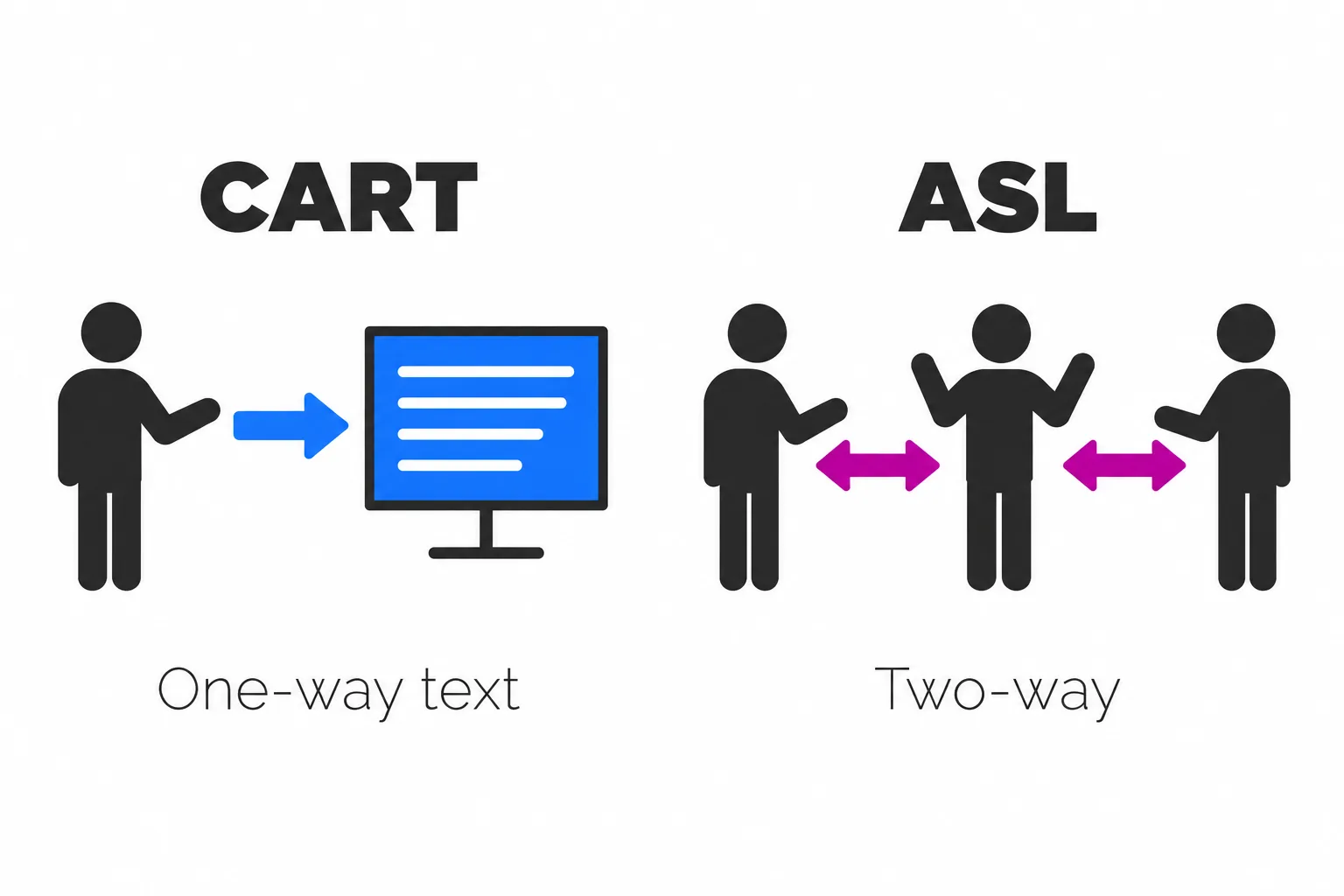
An ASL interpreter works between spoken English and American Sign Language. NIDCD explains that ASL has its own grammar and is distinct from English. Interpreters convey meaning between languages rather than substitute words one by one.
Interpreters carry tone, emphasis, and emotion, and they work in both directions. The Deaf participant signs a question, and the interpreter voices it in English in real time.
An interpreter can attend in person or join through video remote interpreting (VRI). ASL is not universal: confirm which sign language the participant uses and whether additional communication support is needed.
CCI’s sign language and CART services include on-site and remote options. Confirm the required service and assignment details when enquiring.
Related readingDoes a Business Have to Pay for an ASL Interpreter? (ADA)Read the guide →I used CART instead of ASL interpreter for. CART and ASL interpreters provide different kinds of access. I often need both to get full access. …Read on Reddit ↗
| CART Captioning | ASL Interpreting | |
|---|---|---|
| Output | Live text, commonly English | American Sign Language and spoken English |
| Main communication need | Access through readable text | Access through ASL |
| Responding | Plan how the participant will speak, type, or otherwise respond; CART alone does not interpret ASL | The interpreter can voice the participant’s signing and sign spoken responses |
| Written record | A text file may be available if agreed; confirm access, editing, and retention | Interpreting alone does not create a transcript |
| Delivery | On-site or remote | On-site or video remote |
| Long or complex sessions | Confirm breaks, relief, or team coverage | Confirm breaks and whether a team is needed |
How Do You Choose Between CART and ASL?
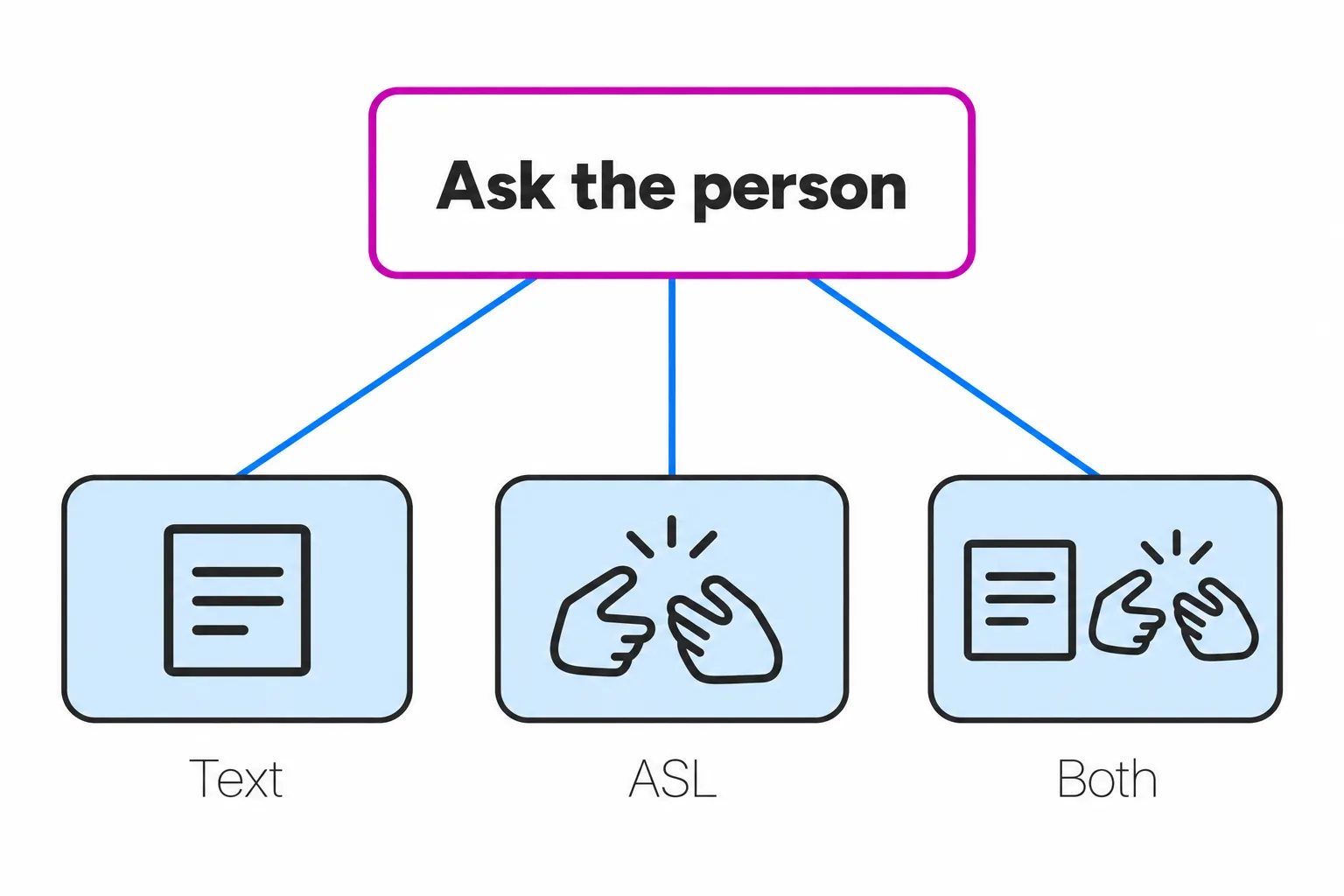
Start with the participant’s request, then check whether the arrangement enables them to understand and participate. A hearing-loss label alone does not tell you which service will work.
CART may suit someone who prefers written English, including some hard-of-hearing or late-deafened people. ASL interpreting may suit someone who communicates in ASL. Some people benefit from both. Do not assume every ASL user has difficulty reading English, or that captions meet every ASL user’s needs.
The ADA effective-communication guidance distinguishes the decision rules:
- State and local governments under Title II must give primary consideration to the person’s requested aid. A different approach needs an equally effective alternative or another legally valid basis.
- Covered businesses and nonprofits under Title III should consult the person; the service provided must enable effective communication.
The nature, length, complexity, and context of the communication also matter. Schools and employers may have additional obligations and individualized processes to follow.
Choosing by Setting: Courts, Classrooms, Clinics, and Meetings
These are planning examples, not fixed rules for every participant:
- Courts and legal settings: Confirm the person’s communication needs, required provider qualifications, and court procedures. CART access text does not replace the official court record.
- K-12 and higher education: Plan for lectures, discussion, technical vocabulary, and visual materials. Confirm whether retained CART text is available for later review.
- Healthcare: Make sure the patient can both understand and respond. Either service may be appropriate depending on the person and encounter; privacy matters in both cases.
- Public meetings, webinars, and emergency briefings: A mixed audience may need both services. Make captions readable and the interpreter visible throughout the presentation.
On-Site or Remote: What Needs to Work?
Remote delivery is useful only when the setup supports effective communication. A remote CART provider needs clear audio from every speaker and a usable text display. VRI needs clear video, suitable lighting, and a view of the participant’s and interpreter’s signing.
Test screen sharing, caption permissions, microphones, and interpreter visibility before the session. Agree on what staff will do if audio, video, or captions fail. If the remote arrangement is ineffective, resolve it or arrange another effective method.
Cost and Who Pays
There’s no single price for either service, so there’s no fixed answer to which costs more. Cost typically depends on session length, minimum booking times, notice given, whether a team is required, travel for on-site work, and remote versus in-person delivery. Request a quote for your specific event.
Ask whether the quote includes preparation, setup, breaks, cancellation terms, and any agreed text file. Compare the same scope rather than assuming CART is always cheaper.
For covered businesses, the ADA’s surcharge rule prohibits charging an individual with a disability for measures required by the law. State and local governments have a separate no-surcharge rule. Confirm which obligations apply to the program, school, or workplace.
Can Automatic Captions Replace CART?
Automatic captions are not the same service as human CART. Do not assume that turning them on provides effective communication. Check names, technical terms, speaker identification, timing, and the actual listening conditions.
For prerecorded media, W3C’s captioning guidance warns that automatic captions need accuracy verification and usually editing. For live sessions, agree on suitable communication support and a backup plan before the event. Enabling captions also does not provide ASL interpreting.
If you plan to publish a recording, arrange caption review and synchronization as a separate deliverable. CCI’s multimedia captioning services cover prerecorded content as well as other audiovisual adaptation.
Booking Checklist: Prepare for Effective Communication
- Ask the participant which service they need and how they will contribute to the conversation. Follow the applicable accommodation process.
- Send agendas, slides, speaker names, and technical terms to providers in advance.
- Confirm the location or platform, readable caption display, interpreter sightlines, and clear audio. Test the full setup.
- Discuss session length, complexity, breaks, and team or relief coverage.
- Agree on transcript delivery, recording permissions, confidentiality, access, and retention before the session.
- Assign a staff contact and a response plan for service or connection problems. Check with the participant that the arrangement works.
CCI Group offers ASL interpreting and CART captioning for institutional and business settings. Public-sector buyers can review its Sourcewell purchasing route and confirm whether the required services, eligibility, and procurement conditions fit their agency.
Planning a class, hearing, appointment, or event? Discuss your accessibility requirements with CCI Group. Share the participant’s request, schedule, format, and subject matter so the team can discuss suitable options and a quote.