

Yes, when an ASL interpreter is necessary for effective communication under ADA Title III, the covered business must provide it without charging the customer. An interpreter is not required for every interaction, but the communication method must work for the person and the situation.
For owners, office managers, and client-service teams, the practical questions are when to book an interpreter, whether video will work, and how to budget for the service.
The Short Answer: The Covered Business Pays for Required Access
Title III applies to public accommodations, including many shops, hotels, banks, medical offices, law offices, and private schools. The duty concerns effective communication, not simply whether someone can hear. Ask how the customer communicates rather than assuming every Deaf or hard-of-hearing person uses American Sign Language (ASL).
This guide focuses on customer-facing services. State and local government duties fall under Title II; employee and job-applicant accommodation questions involve separate employment rules. Do not apply this article as an employment checklist.
Can a Business Charge the Customer or Add a Surcharge?
No. The Title III surcharge rule prohibits charging a person with a disability for measures required to provide nondiscriminatory access. In practice, you cannot:
- Bill the deaf client separately for the interpreter
- Raise their fee or add an interpreter line item to their invoice
- Make payment for a required interpreter a condition of receiving service
Budget for required communication access as an operating expense. The interpreter’s invoice should be handled by your business rather than passed to the customer.
When Is an Interpreter Required Instead of Written Notes?
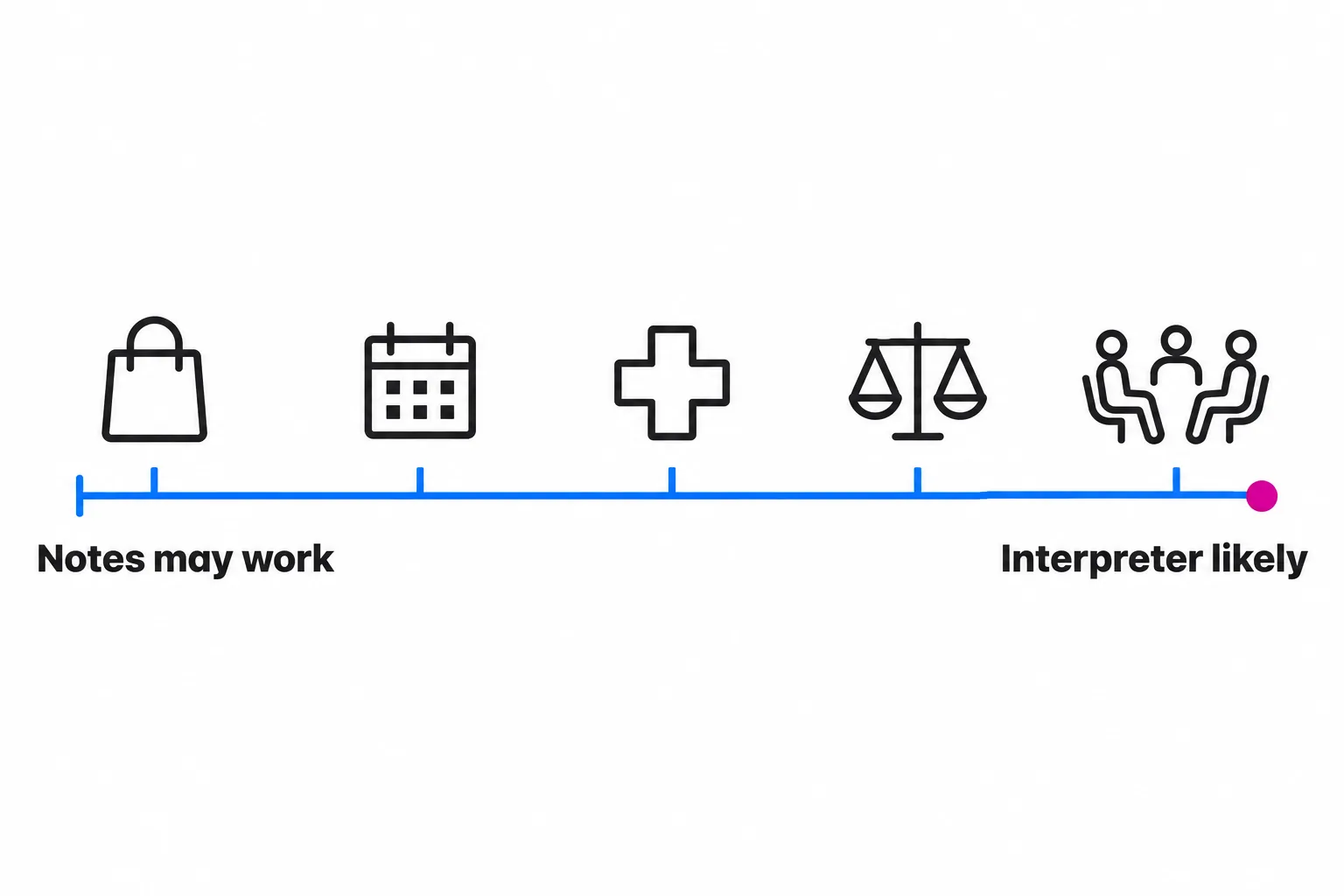
The ADA doesn’t require an interpreter for every interaction. Consider the person’s communication method and the conversation’s nature, length, complexity, and context. Consult the customer when possible. A Title III business may select the aid, but its choice must result in effective communication.
Use the following examples as planning prompts, not automatic legal rules:
| Interaction | What to assess |
|---|---|
| Simple counter purchase | Can the customer and staff exchange the needed information through notes or another effective method? |
| Routine appointment scheduling | Can the person ask questions, understand the details, and confirm the booking? |
| Medical explanation or treatment decision | For an ASL user, plan for a qualified interpreter when notes will not support the discussion. |
| Legal consultation or complex financial agreement | Assess specialized vocabulary, questions, and consequences before deciding on an aid. |
| Long presentation or group discussion | Ask whether interpreting, captioning, or a combination will meet the person’s needs. |
CART provides real-time text captions; ASL interpreting conveys communication in a sign language. They are different services, and one should not automatically replace the other.
The duty can also extend to an appropriate companion with a disability, for example, a Deaf parent involved in a hearing child’s medical discussion. It is not limited to the person receiving treatment or making the purchase.
What Counts as a Qualified Interpreter?
The ADA definition requires effective, accurate, and impartial interpreting in both directions, including necessary specialized vocabulary. Basic sign-language knowledge does not establish that someone can handle a medical, financial, or legal conversation.
When booking, describe the subject matter and ask about relevant experience, credentials, and any state licensing requirements. A credential alone does not establish suitability for every assignment.
Can a Business Ask Family Members to Interpret?
It cannot require the person to bring an interpreter. Under the auxiliary-aids regulation, reliance on an accompanying adult is restricted to:
- An imminent-threat emergency when no interpreter is available; or
- A specific request by the person with a disability, agreement by the adult, and circumstances in which relying on that adult is appropriate.
A minor child may be relied on only in the imminent-threat emergency exception when no interpreter is available. Convenience or a routine scheduling gap is not that exception.
Is Video Remote Interpreting (VRI) Acceptable?
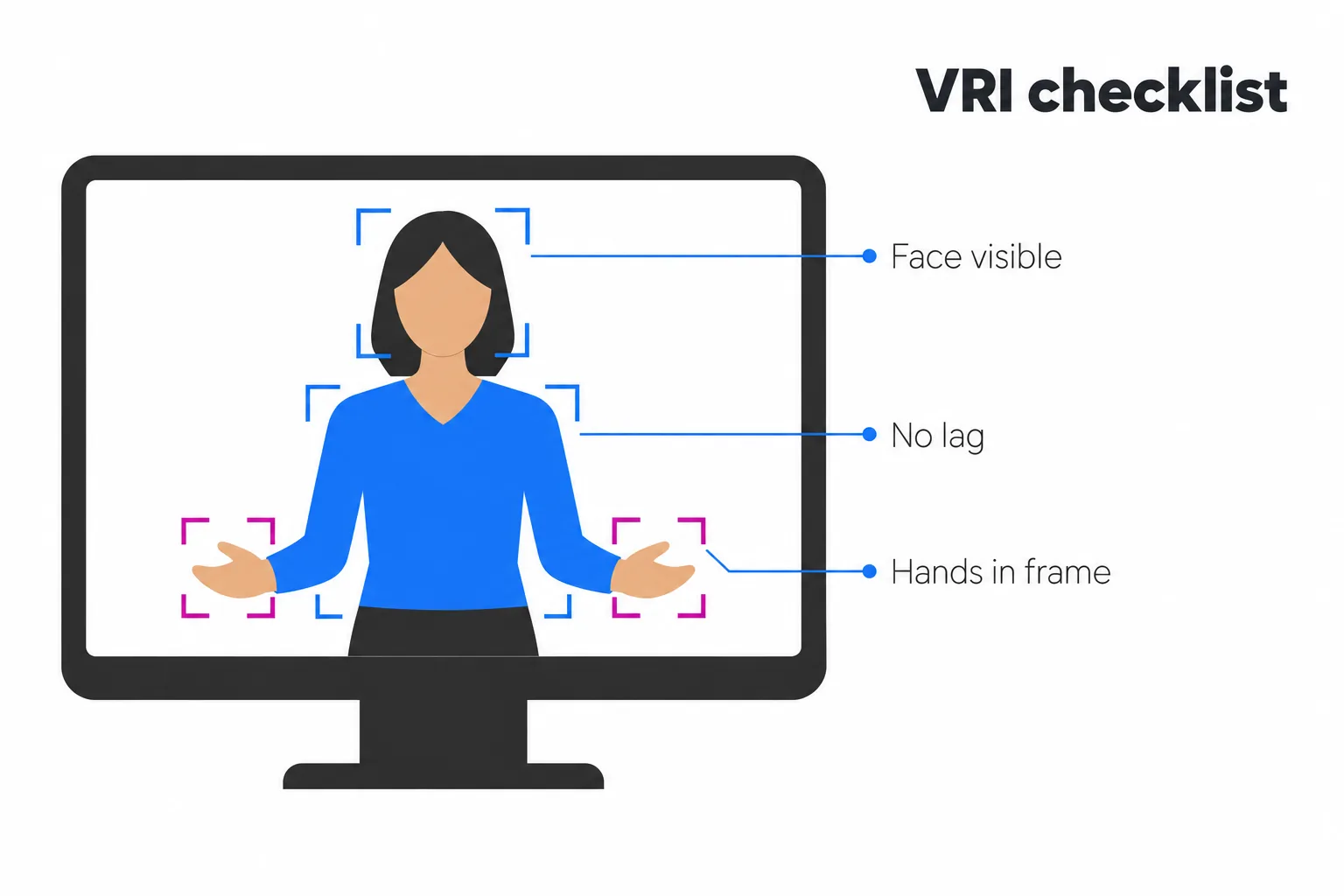
Yes, when it meets the standard. Video remote interpreting (VRI) must support effective communication, not merely connect a video call. Check these features before the appointment:
- Smooth, real-time video without disruptive lag, blurring, or pauses
- An image large and clear enough to show both the interpreter’s and participant’s faces, arms, hands, and fingers
- Clear audio for the hearing participants and interpreter
- Staff who can set up and operate the equipment promptly
The DOJ’s effective-communication guidance explains these standards and why VRI may not work when someone cannot see or be positioned to use the screen. Arrange an effective alternative when video fails; an on-site interpreter may be needed.
For service planning, CCI Group’s remote and on-site interpreting options provide a starting point. Confirm ASL availability and suitability for the specific appointment.
Does a Small Business Have an Exemption?
Small size alone does not exempt a covered public accommodation. Title III recognizes undue burden, meaning significant difficulty or expense, and fundamental alteration. The assessment considers resources and operations; comparing one appointment’s fee with its interpreter cost does not settle it.
If a particular aid presents an undue burden, another effective aid should be provided if possible without that burden. Seek advice before refusing a request on this basis. A cheaper option is useful only if it works.
Can Tax Credits Help Cover Interpreter Costs?
Eligible small businesses may claim the Disabled Access Credit for qualifying expenses, including qualified interpreters. The IRS Form 8826 instructions describe eligibility: prior-year gross receipts of no more than $1 million or no more than 30 full-time employees, subject to the form’s definitions and other rules.
Related readingHow Much Does Video Remote Interpreting Cost for a BusinessRead the guide →The credit is generally 50% of eligible expenditures above $250 and up to $10,250, for a maximum of $5,000. For example, $1,250 of qualifying expenses produces a $500 calculated credit before other applicable limits.
Ask a tax professional to confirm eligibility and treatment. The same expense cannot also receive a deduction to the extent it is used for this credit. Do not delay required access while waiting for tax relief.
How to Arrange an ASL Interpreter
Give staff a practical booking and backup process:
- Ask about communication needs. Record the requested language or aid and relevant access needs.
- Describe the appointment. Give the provider its duration, subject, format, location, and number of participants.
- Confirm suitability and availability. Ask about relevant interpreter experience and any equipment or positioning needs.
- Request an itemized quote. Check minimum booking periods, travel, cancellation terms, and any additional arrangements before confirming.
- Test the setup. For VRI, check the connection, camera, screen, lighting, and privacy. Name a staff member to manage problems.
- Check communication during the meeting. If the arrangement is failing, act on it and use the backup plan.
- Keep an appropriate record. Document the request, arrangements, and problems resolved without collecting unnecessary sensitive information.
Early requests help planning. DOJ guidance allows reasonable advance notice but cautions against excessive notice requirements; handle walk-in needs to the extent possible.
How CCI Group Can Support Your Business
CCI Group offers ASL interpreting and accessibility services, including on-site and video options, with CART available as a separate captioning service.
Share the appointment details and the person’s communication needs to discuss a suitable arrangement. Confirm the proposed service, availability, qualifications, and fees before booking. Working with a provider supports your access process; your business still needs to check that communication is effective.