

Two words are used as if they were interchangeable. A court clerk asks for a certified translation of a birth certificate. A consulate asks for a notarized one. The immigration checklist phrases it a third way. Submitting the wrong version can cause delays or require you to resubmit the document, especially when a filing deadline is approaching.
Here is the difference and what each one is actually used for.
Certified vs Notarized Translation at a Glance
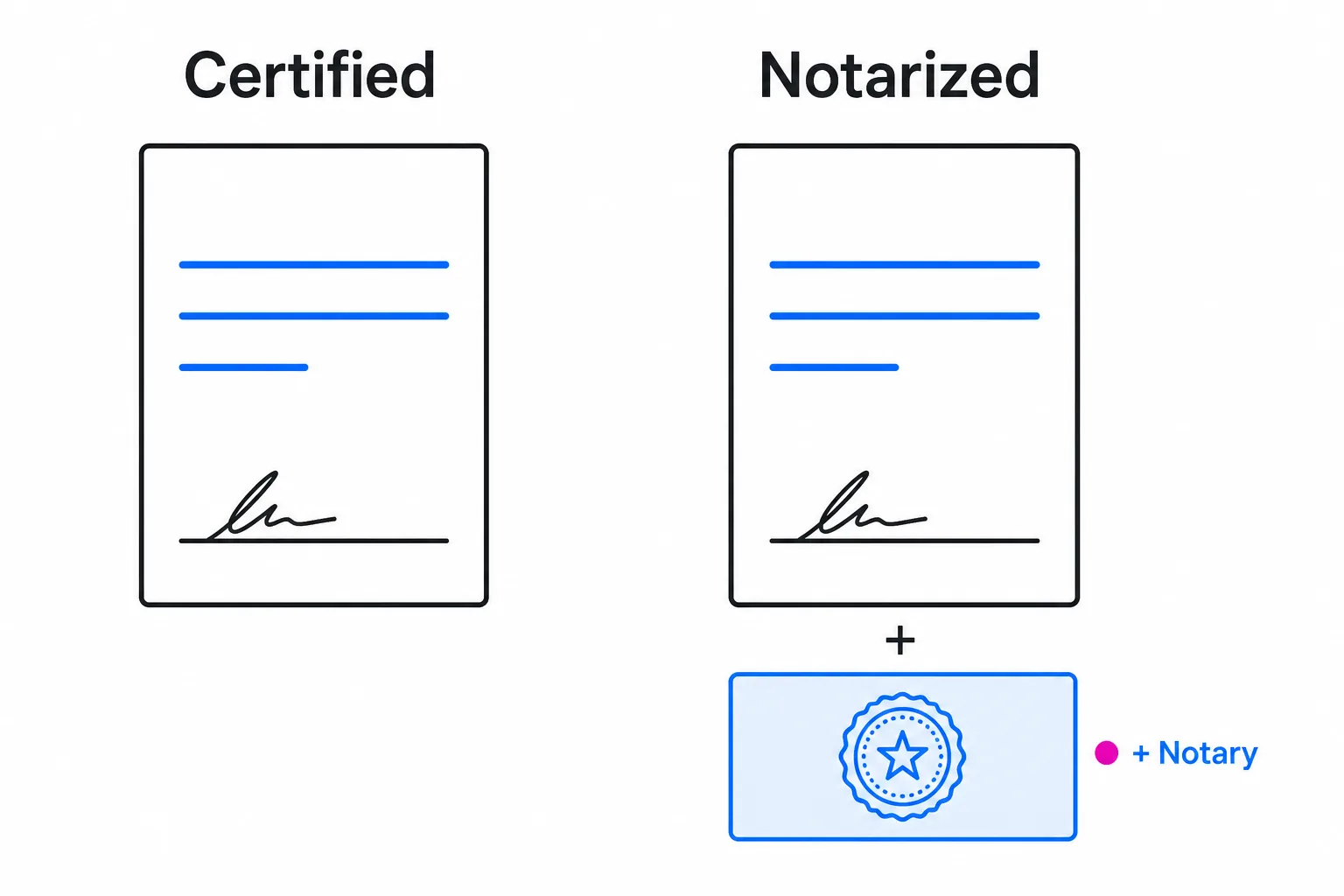
A certified translation comes with a signed statement, usually called a certificate of accuracy, in which the translator or translation company attests that the translation is complete and correct. It speaks to the content.
A notarized translation adds a notary public who witnesses the translator signing that statement and verifies the signer’s identity. It speaks to who signed, not to how good the work is. The notary is not reading the Spanish, Haitian Creole, or Portuguese, and in most cases could not evaluate it even if they tried.
Two things follow from that:
- A notarized translation generally consists of a certified translation with an additional notarial step. You are not choosing between accuracy and identity verification. You are deciding whether the identity step is required.
- Neither is a government license. The United States does not have a federal licensing system for translators. A “certified translation” describes a document accompanied by a signed certification statement, while a “certified translator” is a person who has earned a professional credential, such as certification from the American Translators Association. A certified translation does not always have to be prepared by an ATA-certified translator, although the receiving authority may impose its own qualification requirements. The American Translators Association also explains that a notary verifies the certification signer’s identity rather than the translation itself.
| Comparison | Certified translation | Notarized translation |
|---|---|---|
| What it confirms | The signer attests that the translation is complete and accurate | The identity of the person signing the certification statement |
| Who signs | The translator or an authorized company representative | The certifying signer, with a notary completing the notarial certificate |
| What is attached | Signed certificate of accuracy with the translated document | The same certificate, plus a notarial block, seal, and signature |
| Typical uses | USCIS filings, academic records, court documents, and official records | Certain foreign submissions, consular matters, state requirements, and documents requiring authentication |
| Translation quality verified by a notary? | Not applicable | No |
| Effect on cost and timing | Standard translation and review process | May add cost and processing time |
What a Certified Translation Actually Is
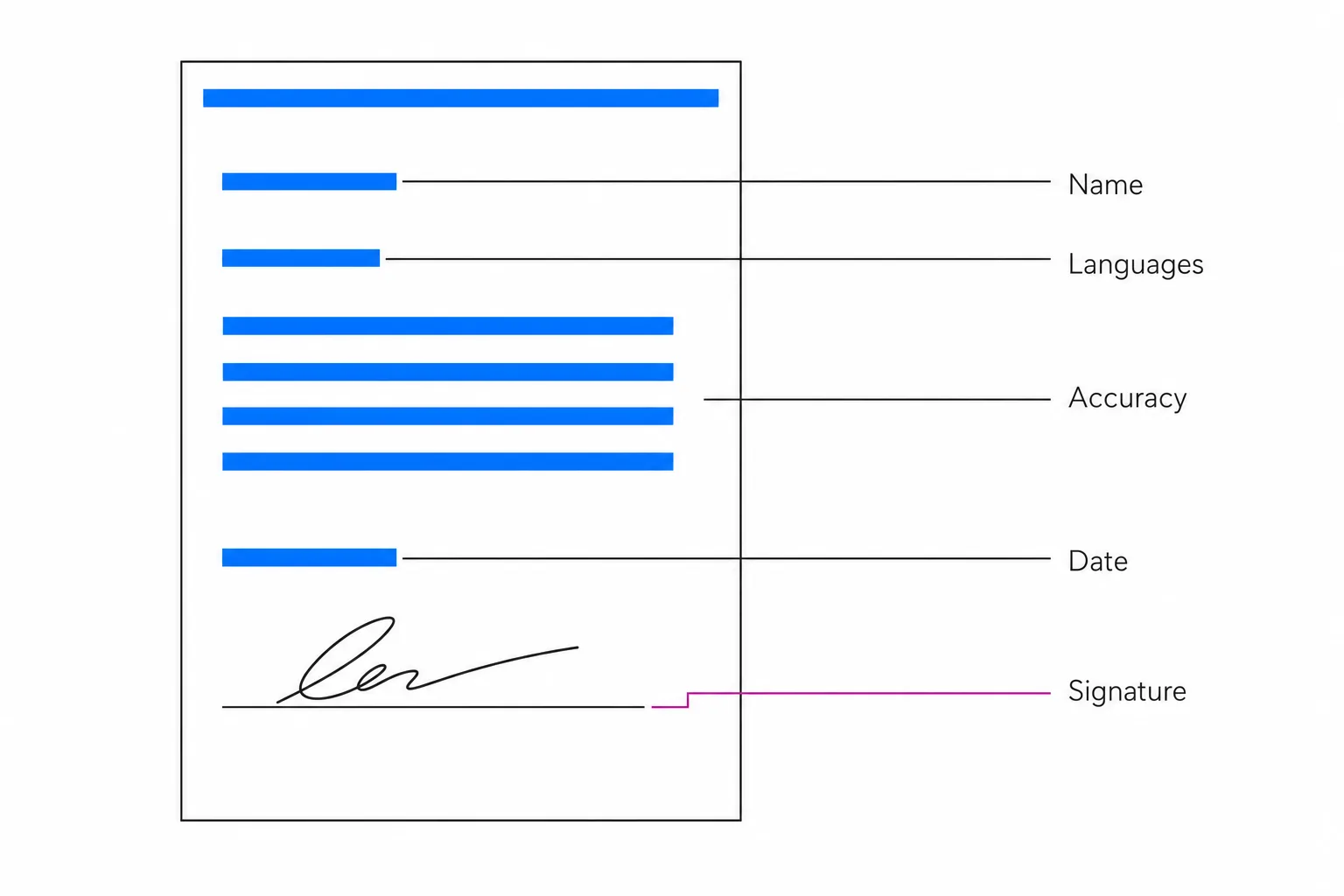
The translated document travels with a short signed statement. That statement normally includes the translator’s or company’s name and contact details, a declaration of competence in both languages, a declaration that the translation is a complete and accurate rendering of the original, a description of the document translated, and a dated signature. Many providers issue it on company letterhead so the receiving office can trace it back to a real business.
An example reads close to this: “I, \[name\], certify that I am competent to translate from Spanish into English and that the attached translation of the Venezuelan birth certificate of \[name\] is a complete and accurate translation to the best of my knowledge and ability.” Then a signature, a date, and contact information. Nothing more elaborate.
If someone hands you a translation with a decorative stamp and no signed accuracy statement, you do not have a certified translation.
Formatting matters more than people expect. Certified translations should completely and accurately represent the source document, including visible seals, stamps, annotations, and signature lines. Illegible content should be identified rather than guessed, cleaned up, summarized, or omitted. Missing or altered source content may cause the receiving authority to question or reject the submission. Our breakdown of what counts as a certified translation walks through the full process, from source review to the final signed certificate.
When a Certified Translation Is Enough
For many U.S. submissions, certification alone may be sufficient, but the receiving authority determines the final requirement:
- Immigration filings. USCIS generally asks that a foreign-language document be filed with a full English translation plus the translator’s signed certification of accuracy and of competence to translate. Notarization is not part of that standard request. Check the instructions for your specific form before you order. See the USCIS requirements for foreign-language evidence.
- University admissions and credential evaluation. Transcripts, diplomas, and course descriptions may need certification. Some institutions require an approved translation or credential-evaluation provider, so check the institution’s instructions first.
- Courts and case preparation. Courts may require certified translations for foreign-language evidence, but the exact certification, affidavit, formatting, and filing requirements vary by jurisdiction and proceeding. CCI Group also provides language solutions for legal and government organizations.
- Medical, insurance, and corporate records. Claims files, clinical records, vendor agreements, and compliance documentation may require certification rather than notarization. Confirm the receiving organization’s requirements.
USCIS, the National Visa Center, U.S. passport services, and individual U.S. embassies do not always use identical document rules. Check the instructions for the exact agency and application process. The U.S. Department of State’s civil-document guidance explains requirements for immigrant-visa civil documents.
For legal teams, the practical concern is rarely the certificate itself. It is turnaround, chain of custody, and confidentiality on sensitive material. Ask how linguists are selected, how translations are reviewed, and how sensitive files are handled before placing an order.
What Notarization Adds, and What It Does Not
Notarization is an identity procedure. The person signing the certificate completes the required identity-verification and signature process before a notary public. The exact procedure may depend on the notarial act and applicable state law. The notary completes a notarial certificate, signs, and applies a seal. That is the entire added value: a public officer confirming that the named person really signed.
A notary does not verify the translation, does not approve the translator’s qualifications, and does not make an inaccurate translation acceptable.
Notarization should therefore not be treated as evidence of translation quality.
Ask for notarization when the requesting party specifically says so. That most often shows up with certain state and local agencies, some foreign consulates and embassies, corporate documents being filed with a foreign registry, some academic institutions abroad, and documents that require a notarized signature before apostille or authentication processing. Learn more about CCI Group’s remote notarization and apostille services.
Sworn Translations, Apostilles, and Terms That Confuse U.S. Filers
If a document is heading overseas, two other words tend to appear.
A sworn translation is a concept from civil law countries, where a translator is appointed or authorized by a court or ministry, and their signature and stamp carry official weight. The United States has no single nationwide equivalent register. A U.S. certified translation, even when notarized, should not automatically be treated as equivalent to a destination country’s sworn translation. Confirm with the receiving authority before assuming the two are equivalent.
An apostille authenticates the signature and seal of a public official, such as a notary, for use in countries party to the Hague Convention. It is issued by the relevant competent authority, not by a translator, and it says nothing about translation quality. Where an apostille is needed, the sequence usually runs translate, certify, notarize, then apostille, but the correct process depends on the document, jurisdiction, and destination country. Our guide to certified document translation cost per page covers how certification, notarization, and apostille stack together and where each one adds a fee.
One more distinction worth naming: translation covers written documents, while interpretation covers live spoken language, whether in person or over the phone. The certification rules described here apply to written documents only.
A certified copy is also different from a certified translation. A certified copy confirms that a copy matches an original record. A certified translation contains an attestation about the completeness and accuracy of content translated from one language into another. A receiving authority may request one or both.
Which Translation Requirement Applies?
| Submission type | Common requirement | What to verify |
|---|---|---|
| USCIS filing | Certified English translation | Instructions for the specific USCIS form |
| U.S. university | Certified translation may be required | Approved provider or evaluator requirements |
| U.S. court | Varies | Court and jurisdiction-specific filing rules |
| Foreign authority | Certification, notarization, apostille, or legalization may apply | Destination-country requirements |
| U.S. passport evidence | Special translation instructions may apply | Current Department of State guidance |
| Consulate or embassy | Varies by post and document | Instructions from the specific embassy or consulate |
This table provides general guidance. The receiving authority’s current instructions control the final requirement.
Cost and Timing
People searching for how much it costs to translate legal documents usually want a per-page or per-word answer. A handful of variables drive it: page count and word density, the language pair, whether the source is a clean digital file or a scanned document full of stamps and handwriting, formatting complexity, and turnaround speed.
Certification may be included in a professional translation quote, while notarization can add cost and processing time because it requires an additional notarial step. Ordering notarization you do not need can result in unnecessary expense.
CCI Group provides project-specific quotations based on the document and requested services. Cost may depend on the language pair, word count, document condition, formatting, certification, notarization, delivery format, and deadline. Notarization and apostille coordination may be separate services, so request a quote based on the document’s actual requirements.
How to Ask for the Right One
Before ordering, get four answers from the office that will receive the document:
1. Do they require certification only, or certification plus notarization?
2. Do they accept a digital PDF with a signed certificate, or do they need hard copies with wet signatures?
3. Will the document later need an apostille or consular legalization?
4. What is the actual filing deadline, not the internal one?
Those four answers determine the whole order. Do not order based on assumptions. If the instructions are unclear, request written confirmation from the receiving authority before choosing certification, notarization, or apostille processing.
CCI Group provides certified document translation services for immigration, academic, legal, government, and international submission purposes across hundreds of languages and dialects. Final acceptance depends on the receiving authority’s requirements. If you are unsure which one your filing needs, call (727) 657-3167 and describe the document and the receiving agency. You can also learn more about CCI Group before requesting service.
Related readingJapanese Translation Services | Certified Document Translation | CCI GroupRead the guide →