

A certified interpreter usually costs $75 to $150+ per hour for many in-person assignments in 2026, although the final rate depends on the language, setting, credentials, location, and delivery format. ASL, legal, medical, conference, emergency, and rare-language work can cost more. Phone and video interpreting are often priced by the minute, which may be cheaper for short calls but less practical for long or sensitive appointments.
In this article, we explore how certified interpreter pricing works, what affects hourly rates, when phone or video support makes sense, and how organizations can budget for professional language access without cutting corners.
How Much Does a Certified Interpreter Cost Per Hour in 2026?
For most U.S. buyers, a realistic planning range is $75 to $150+ per hour for certified in-person interpreter services. Legal, medical, ASL, rare-language, urgent, or highly technical assignments often sit above that range because they demand stronger credentials, deeper subject knowledge, and tighter quality control.
That answer may feel broad. It is. Interpreter cost is not priced like a simple product on a shelf. A court hearing, a parent-teacher meeting, a patient consent appointment, a public agency briefing, and a corporate training session all place different demands on the interpreter. The same language pair can carry different rates based on the stakes of the conversation.
Here’s the thing: “certified interpreter” does not mean one universal credential. A court may require a court-certified interpreter. A hospital may need a trained or certified medical interpreter. A Deaf attendee at a public meeting may need a qualified sign language interpreter. A federal agency may need a provider that understands procurement, accessibility, security, and compliance.
That is why the better question is not only how much does a certified interpreter cost per hour. The better question is: what kind of interpreter does this situation require?
Certified Interpreter Hourly Rates by Service Type
The delivery method has a major effect on price. In-person interpreting often uses hourly rates with minimum booking windows. Phone and video interpreting are usually billed by the minute or through scheduled remote blocks. ASL, legal, medical, and conference work may require special credentials or more than one interpreter.
| Service type | Common 2026 pricing model | Typical planning range | Best fit |
| Certified in-person interpreter | Hourly, often with a 2–3 hour minimum | $75–$150+ per hour | Legal, medical, education, HR, public meetings |
| Certified medical interpreter | Hourly, usually with a minimum booking | $100–$140+ per hour | Patient consent, discharge, complex care, telehealth |
| Legal or court interpreter | Hourly, half-day, or full-day | Often quote-based | Hearings, trials, depositions, attorney meetings |
| ASL interpreter | Hourly, often with a 2-hour minimum | $75–$125+ per hour | ADA access, classrooms, events, healthcare |
| Video remote interpreter | Per minute or scheduled hourly | $1.95–$4.95+ per minute | ASL, telehealth, virtual meetings, visual context |
| Phone interpreter | Per minute | $1.25–$3.95+ per minute | Intake calls, customer service, quick admin support |
| Conference interpreter | Half-day or full-day | $600–$1,500+ per day | Summits, panels, multilingual events |
CCI Group provides interpreting and language access services in 350+ languages for legal, healthcare, education, government, corporate, nonprofit, and accessibility-focused settings. That matters because certified interpreter costs depend heavily on the assignment type, compliance risk, and required credential level. A simple call may only need over-the-phone support, while a court proceeding, IEP meeting, public event, or Deaf-accessibility request may call for a certified or specialized interpreter.
These numbers are best used for planning, not as a one-size quote. The U.S. Bureau of Labor Statistics reported that interpreters and translators had a median annual wage of $59,440 in May 2024, and it also notes that pay varies by language, specialty, experience, education, and certification. Wage data is not the same as client billing, of course. Still, it helps explain why skilled professional interpreting costs more than casual bilingual help.
Why Interpreter Cost Changes So Much
A buyer may ask how much a certified interpreter costs per hour and expect one neat number. Fair enough. But interpreter pricing works more like legal or technical services than retail pricing.
Language pair is one driver. Spanish-English interpreters are widely available in many U.S. markets, so rates may be more competitive. Languages with fewer qualified professionals may cost more because the talent pool is smaller. Dialect also matters. “Arabic,” “Portuguese,” “Chinese,” or “Creole” may not be specific enough for a high-stakes assignment.
Subject matter is another driver. A school front-desk call and a neurosurgery consent appointment are not the same job. Medical vocabulary, court procedure, immigration interviews, insurance claims, public safety, finance, social services, and technical product training all require a stronger professional background.
Certification changes the quote too. A certified interpreter has met a formal credential standard or passed a recognized exam. That raises the rate because the buyer is paying for proven skill, ethics, accuracy, impartiality, and reliability.
Location also plays a role. Orlando, New York, Los Angeles, Chicago, Dallas, Miami, and Washington, D.C. do not share the same labor market. Rural assignments may add travel fees. Onsite work may also include mileage, parking, tolls, cancellation terms, after-hours premiums, or minimum booking windows.
Over the Phone Interpreter Rates vs Hourly Rates
Over-the-phone interpreter rates are usually billed per minute rather than per hour. That can be a smart way to control cost when the conversation is short, routine, or unpredictable.
A clinic intake call, customer service issue, school office question, insurance inquiry, or public service call may not justify a two-hour onsite minimum. In those cases, phone interpreting can work well. The problem starts when the call gets long, emotional, technical, or document-heavy. Then a per-minute rate may cost more than a scheduled interpreter.
| Scenario | Phone at $1.75/min | Phone at $3.95/min | Better option |
| 10-minute intake call | $17.50 | $39.50 | Phone |
| 30-minute customer call | $52.50 | $118.50 | Phone or video |
| 60-minute consultation | $105.00 | $237.00 | Compare with onsite or scheduled remote |
| 2-hour meeting | $210.00 | $474.00 | Usually scheduled interpreter |
| Half-day event | Often too high | Often too high | Onsite, VRI, or event package |
This is where buyers often confuse terms. “Phone translation services cost” is a common search phrase, but phone-based language support is usually phone interpreting, not translation. Translation handles written text. Interpreting handles spoken or signed communication in real time.
For regular language access needs, a structured provider is often more practical than one-off calls. CCI Group’s professional interpreting services include onsite, over-the-phone, video remote, simultaneous, consecutive, whispered, escort, and remote simultaneous interpreting options.
How Much Does an ASL Interpreter Cost Per Hour?
ASL interpreter cost usually falls around $75 to $125+ per hour, often with a two-hour minimum. Complex legal, medical, conference, platform, DeafBlind, theatrical, emergency, or Certified Deaf Interpreter assignments may cost more.
People search this topic in many ways: cost of ASL interpreter, ASL interpreter cost, how much does an ASL interpreter cost, cost of sign language interpreter, ASL interpreter cost per hour, how much is a sign language interpreter, and sign language interpreter cost per hour. The answer depends on the setting, the length of the assignment, the interpreter’s credentials, and whether one interpreter is enough.
For a short appointment, one interpreter may be fine. For long sessions, fast dialogue, technical content, legal matters, medical appointments, or public events, two interpreters may be needed. This is not padding the invoice. Sign language interpreting is mentally and physically demanding, and accuracy can drop when the assignment is too long for one person.
There is also a legal access issue. ADA.gov defines a qualified interpreter as someone able to interpret “effectively, accurately, and impartially,” both receptively and expressively, while using any necessary specialized vocabulary. That wording matters because it shows that qualified access is not only about knowing sign language. It is about accuracy, neutrality, and context.
For organizations that need ASL, CART, video remote interpreting, captions, audio description, emergency communication, document accessibility, or Section 508 support, CCI Group’s sign language and accessibility services are directly relevant.
Medical, Legal, and Government Interpreter Cost
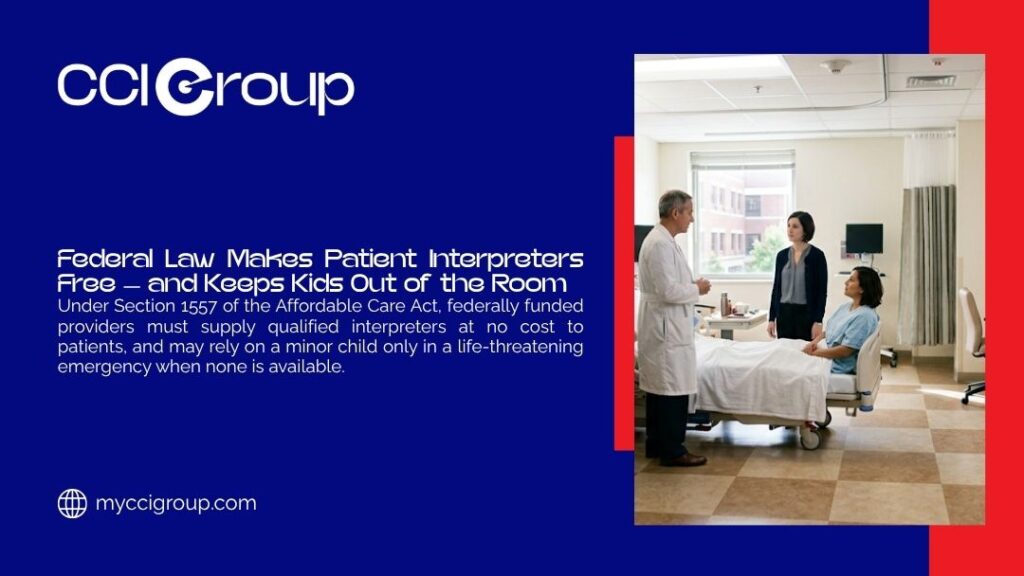
Medical interpreting often costs more because accuracy affects care. Consent, diagnosis, medication instructions, discharge plans, mental health evaluations, and emergency treatment leave little room for guesswork. Many certified medical interpreter assignments fall around $100 to $140+ per hour, usually with minimum booking time.
Legal interpreting has its own pressure. Court-certified interpreters, deposition interpreters, immigration interpreters, and attorney-client interpreters may charge hourly, half-day, or full-day rates. Public-sector buyers face an extra layer of scrutiny beyond rate comparison, so it helps to review our buyer’s checklist for vetting a language service provider for government work before you request quotes. A deposition with exhibits, objections, and technical testimony costs more than a brief consultation because the interpreter must keep pace with legal terminology and procedure.
Government pricing can differ again. Public agencies may need interpreters through cooperative contracts, procurement vehicles, public bids, federal schedules, or pre-approved vendor systems. For agencies, the “cost” of hiring an interpreter also includes the time it takes to buy the service correctly.
This is one place where CCI Group’s public-sector positioning becomes important. CCI Group is available through Sourcewell contract language services and publicly lists 350+ languages, 24/7/365 availability, 8(a), WOSB, and EDWOSB certifications, plus GSA Schedule Contract Holder status. For government buyers, that can reduce procurement friction while keeping language access aligned with agency requirements. Public agencies can review CCI Group’s Sourcewell contract language services for procurement details.
How Much Does It Cost to Hire a Translator?
Translation and interpreting are often grouped, but they are not the same service. Interpreting is real-time spoken or signed communication. Translation is written-language work.
So, how much does it cost to hire a translator? Written translation is usually priced per word, per page, per document, or by project. Certified translation for immigration, legal, academic, medical, financial, or government use may include a minimum fee. Cost for translation services per hour may apply when the work involves editing, review, formatting, machine translation post-editing, consulting, or live document support.
This section matters because some buyers arrive with the wrong term. A birth certificate, legal affidavit, transcript, contract, medical record, or immigration document needs translation. A court hearing, patient visit, school meeting, public event, or business call needs interpreting.
For written documents, CCI Group’s certified translation services are a better fit. For closings, affidavits, international paperwork, and notarized multilingual documents, CCI Group’s multilingual notarization services may also help.
What You Actually Pay For
A certified interpreter’s hourly rate covers more than the time spent in the room. Behind that rate are credential checks, scheduling, preparation, terminology review, confidentiality practices, travel coordination, secure technology, quality control, backup planning, and project management.
With a freelancer, the hourly rate may look lower. With a language services provider, the invoice may include vetting, insurance, platform access, compliance support, multilingual coverage, and emergency replacement options. For a low-risk conversation, a freelancer may be enough. For a hospital, court, school district, government office, or national company, the added structure can be worth the extra cost.
That is where professional interpreting differs from casual bilingual support. A bilingual employee may speak two languages well, but that does not make them trained in ethics, impartiality, confidentiality, role boundaries, memory technique, or specialized terminology. In sensitive settings, the cheap shortcut can become the expensive mistake.
Hidden Costs That Change the Quote
The hourly rate is only part of the bill. Minimum booking time is often the first surprise. A 30-minute onsite appointment may still carry a two-hour or three-hour minimum because the interpreter has to block travel and schedule time around that job.
Cancellation terms matter too. If a client cancels too late, the interpreter may still need to be paid. Rush requests can add a premium, especially for rare languages or certified specialists. Knowing what to spell out in an interpreter services RFP keeps minimums, cancellation terms, rush fees, and travel from turning into surprises after the contract is signed. After-hours, weekend, holiday, and emergency requests may also cost more.
For onsite work, travel can change the total. Some providers include local travel. Others charge mileage, parking, tolls, transit, lodging, or portal-to-portal time. For events, the quote may also include microphones, headsets, booths, caption support, video platforms, rehearsal time, or technical coordination.
How to Lower Interpreter Cost Without Lowering Quality
The best way to control interpreter cost is to match the format to the risk. Use phone interpreting for brief, routine calls. Use video when visual cues matter. Use onsite interpreting for legal, medical, ASL, public meetings, sensitive HR matters, and events where trust and body language matter.
Preparation helps too. Send agendas, names, acronyms, terminology, slide decks, documents, and the expected run time in advance. A prepared interpreter can work more accurately and with fewer pauses. For recurring needs, it may also help to bundle demand across departments instead of creating a string of urgent one-off requests.
Do not book a certified legal interpreter for a basic front-desk call. Also, do not use casual phone interpreting for a court hearing. The wrong match can raise the cost and the risk at the same time.
For organizations with multilingual websites, training, software, event media, or global campaigns, the need may go beyond live interpretation. CCI Group’s localization and multimedia services can support website localization, multilingual SEO, subtitles, voiceover, e-learning, and culturally adapted content.
Interpreter Cost by Buyer Type
| Buyer type | Typical need | Cost risk | Best-fit service path |
| Law firm | Depositions, hearings, client meetings | Misstated testimony or privilege issues | Certified legal interpreter |
| Clinic or hospital | Patient intake, consent, discharge | Care errors and compliance exposure | Certified medical interpreter, OPI, VRI |
| School district | IEPs, parent meetings, ASL access | Access complaints and family confusion | Onsite, ASL, VRI, translation |
| Government agency | Public access, emergency response, meetings | Title VI, ADA, procurement delays | Contract-ready language provider |
| Business | HR, customer calls, events, training | Brand, safety, and employee relations risk | Interpreting plus translation |
| Nonprofit | Community access, outreach, case support | Limited reach and service inequity | Multilingual language access plan |
This table shows why how much does a certified interpreter cost per hour is only half the story. The real value comes from choosing the right language access model for the setting.
Why CCI Group Can Speak to Certified Interpreter Cost
CCI Group is not just a general translation vendor. Founded in 2012 and based in Orlando, Florida, the company grew from legal and court interpreting roots into a broader language access partner for government agencies, schools, law firms, healthcare organizations, businesses, nonprofits, and global teams.
That background matters because interpreter pricing is tied to risk. A public agency needs compliance-ready support. A legal team needs accuracy and confidentiality. A school may need spoken-language support, ASL, translated notices, and family access. A healthcare provider may need medical interpreters, OPI, VRI, and urgent response. A company with global teams may need interpreting, translation, localization, and multilingual workforce support under one roof.
CCI Group’s industry language services show how interpreting, translation, accessibility, localization, staffing, and notarization can support different sectors. Readers who want to understand the company’s background can also review CCI Group’s company story and leadership team.
FAQs About Certified Interpreter Cost
Is a certified interpreter more expensive than a bilingual employee?
Yes, usually. A certified interpreter costs more because they bring tested language skills, professional ethics, impartiality, confidentiality, and subject-matter accuracy. A bilingual employee may help with casual conversation, but legal, medical, government, education, and accessibility settings often need trained professional interpreting.
Do interpreters charge a two-hour minimum?
Many onsite interpreters do. A two-hour or three-hour minimum is common because the interpreter must reserve time, travel, prepare, and block the appointment on their schedule. Phone and video interpreting may avoid that minimum when billed per minute.
Is phone interpreting charged per minute or per hour?
Phone interpreting is usually charged per minute. That makes it useful for short calls, intake, customer support, and quick questions. For long sessions, scheduled remote or onsite interpreting may offer better value.
How much does an ASL interpreter cost per hour?
An ASL interpreter often costs about $75 to $125+ per hour, with a minimum booking window. Complex medical, legal, conference, DeafBlind, platform, or emergency work may require higher rates or a team of interpreters.
Who pays for a sign language interpreter?
In many ADA-covered situations, the business, public entity, or organization responsible for communication access provides the qualified interpreter or auxiliary aid. The person who is Deaf or hard of hearing is generally not expected to bring or pay for their own access support.
Are translation and interpreting priced the same?
No. Interpreting is real-time spoken or signed communication and is often billed hourly or by the minute. Translation is written-language work and is usually priced per word, page, document, or project.
How much does an interpreter cost for a full-day event?
Full-day event interpreting may range from several hundred dollars to more than $1,500 per interpreter, depending on the language, subject matter, format, location, equipment, and whether multiple interpreters are required. Conferences and simultaneous interpreting usually cost more than basic consecutive interpreting.
The Smart Way to Budget in 2026
How much does a certified interpreter cost per hour? A safe estimate is $75 to $150+ per hour for certified in-person interpreting, $100 to $140+ per hour for many certified medical assignments, $75 to $125+ per hour for ASL, and $1.25 to $4.95+ per minute for phone or video interpreting.
The lowest rate is not always the best value. A five-minute phone call does not need a full onsite booking. A court hearing should not rely on an untrained bilingual speaker. A Deaf attendee at a public meeting should not be treated as an afterthought. The right interpreter protects the conversation, the people in it, and the organization behind it.
For certified interpreting, ASL access, translation, localization, multilingual notarization, or public-sector language support, request a tailored quote through CCI Group. A clear scope can help you get the right interpreter, the right format, and a price that makes sense before the appointment starts.